Rupee Prices strengthen India`s Base Metal Price Discovery
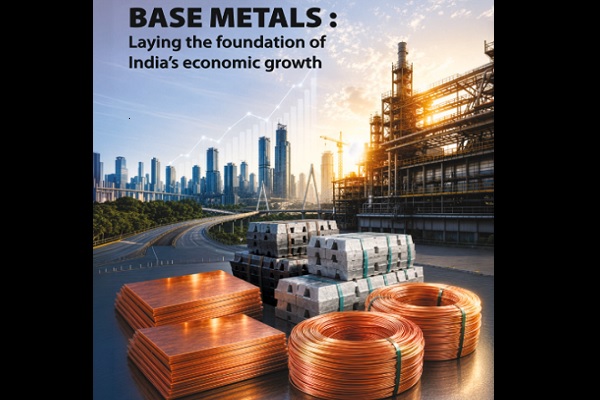
Base metals such as aluminium, copper zinc are a critical part of India's economic growth story. A new report says the derivatives market built on these metals is an important part of the same story.
The report, 'Base Metals: Laying the Foundation of India's Economic Growth', released by the Multi Commodity Exchange of India (MCX) at the Global Commodity Conference, states rupee-denominated prices on India's commodity derivatives market are used by smelters, fabricators, traders, and manufacturers to price physical transactions, hedge exposure, and plan production.
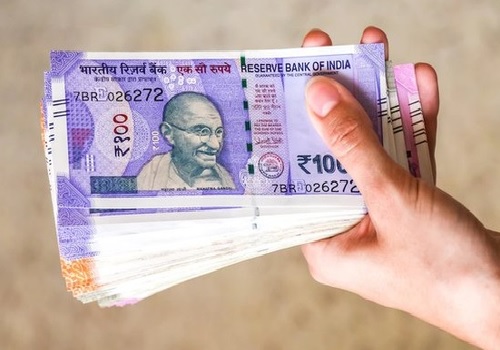
The rupee-denominated, exchange-discovered price referred to in industry parlance as ‘MCX Price’ is becoming the reference point for aluminium, copper, lead, zinc and nickel across the Indian value chain. Unlike some international reference prices, which reflect international fundamentals and exchange rate movements, MCX prices better reflect Indian demand-supply dynamics, duty structures, and logistics costs, making them relevant benchmarks for domestic contracts, tenders, and internal pricing formulas used by smelters, fabricators, and traders. It makes the prices a relevant benchmark for local contracts, tenders, and internal pricing formulas.
Use of domestic exchange-discovered commodity prices as reference
India's commodity derivatives market, including the base metals segment, is one of the fastest-growing in global commodities. Indian entities with exposure to base metals have prices reflecting Indian market fundamentals. These INR-denominated prices should also be used as the reference in fixing customs duties, export incentives and other policy mechanisms. This, the report argues, will give India a credible, self-sufficient reference point and reduce the need to anchor Indian trade and procurement decisions to international prices.
If government departments and Central Public Sector Enterprises (CPSEs) take the lead, corporate India will follow. This will promote the indigenisation of commodity prices and encourage users to rely on Indian prices.
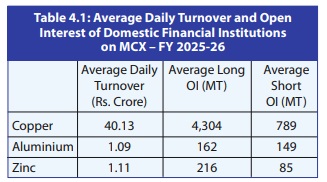
The market has become deeper since metal contracts moved to compulsory delivery in 2019. Liquidity in copper and zinc derivatives has averaged about two and a half times stakeholders' exposure in these metals. The report states that close to six lakh tonnes of metal have been delivered through these warehouses since 2019, including during the pandemic lockdowns, when much of the physical market shut down but exchange trading continued without interruption.
It calls for hedging in INR-denominated derivative instruments to encourage those looking to hedge abroad. It will also help save forex outflows. RBI guidelines for hedging in international markets exclude gold from commodities whose price risk can be hedged overseas. This, the report says, means interest in gold hedging has seen an uptick in increased open interest in gold derivatives on domestic exchanges. The increase in domestic hedging, in turn, has supported the bullion economy in India.
It estimates companies hedging domestically can save about 1.5 and 2% of contract value in currency conversion and clearing costs. According to the report, for domestic investors, there are no options to hold aluminium, copper, lead, nickel, or zinc as a financial asset. This means derivatives emerged as the primary route to the asset class. Moreover, these instruments are not tied to equities and instead move with the US Dollar Index. This, the report argues, helps base metals derivatives diversify an investment portfolio. Contracts come in different sizes, which means the market is open to large corporate treasuries, smaller hedgers and individual investors.
Room for further development
The report argues that the market remains well below its potential, and closing the gap will require policy shifts. This includes linking customs duties, export incentives, and government procurement to domestic rupee prices instead of international prices. It also calls for getting more investors into the market, since presently Foreign Portfolio Investors, banks, insurers, and pension funds cannot participate. It also calls for tweaking GST norms to encourage metal trade across states and letting banks lend against metal stored in approved warehouses, to make sure stored metal can be used as security for a loan.
The industry calls for more investors into the market, since presently Foreign Portfolio investors (FPIs), banks, insurers, and pension funds cannot participate. It also calls for letting banks lend against metal stored in approved warehouses, to make sure stored metal can be used as security for a loan.
The way forward is clear. India's industrial and infrastructure sectors are expanding, and its markets are growing, along with the wider domestic economy. Base metal derivatives are between these developments, linking industry with investment, growth with stability. With greater institutional participation and supportive policy actions, base metal derivatives can become one of the most dynamic pillars of India's financial system.
Above views are of the author and not of the website kindly read disclaimer