Non-Life Premium Growth Rises to 10.5% in October 2026 by CareEdge Ratings

Synopsis
• Non-life insurance premiums grew 10.5% y-o-y in October 2026, against 6.1% in September, supported by a low base in October 2025. YTD FY27 growth stood at 9.1%.
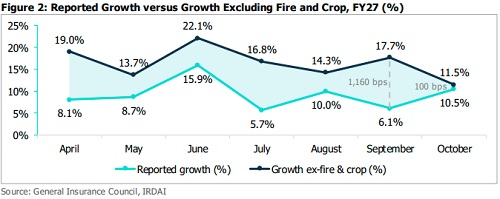
• Fire premium returned to growth, and the fall in crop premium narrowed sharply, though crop premium is still declining. The gap between reported growth and growth excluding fire and crop narrowed to about 100 bps, from about 1,160 bps in September.
• Health premium growth slowed to 16.1% y-o-y and retail health to 25.9%. This is the first month in FY27 in which retail health grew below 30%. The GST exemption on individual health policies has now been in place for a full year, so last October's premium already included its effect.
• Motor premium growth slowed to 6.5% y-o-y on account of a higher base last year, which was aided by festive sales.
• Private insurers and standalone health insurers together wrote 67.7% of October premium.
Industry Premium Grows 10.5% in October on a Low Base
Non-life insurance premiums stood at Rs 32,761 crore in October 2026. October 2025 was flat, with growth of 0.1% y-o-y, so most of this month's higher rate comes from a low base. Fire and crop remained a drag on growth in every month of FY27 so far. In October, fire premium returned to growth, and the fall in crop premium narrowed sharply, though crop premium is still declining. Together,the two segments added Rs 13 crore to industry premium, against Rs 2,103 crore taken away in September. Health and motor account for most of the increase, rising by Rs 1,998 crore and Rs 722 crore respectively, out of a total increase of Rs 3,120 crore.
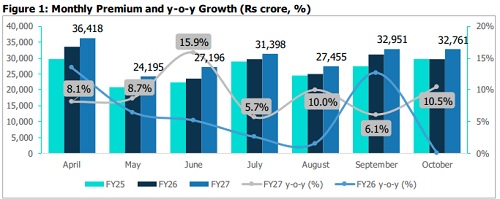
Source: General Insurance Council, IRDAI. Note: Monthly figures are as reported in each month's release. YTD totals reflect later revisions by the General Insurance Council.
Private and Standalone Health Insurers Contribute 67.7% to Total October Premium
Private insurers and standalone health insurers (SAHIs) together wrote 67.7% of total October premium, continuing the steady gain over the past two years; for YTD FY27, their combined share was 67.5%, up from 64.1% a year earlier. SAHIs grew fastest of the four groups in the month, though their growth has slowed to 21.3% from 27.1% in September, following the slowdown in retail health. Public sector general insurers’ growth was slower than the industry in both the month and YTD FY27. Health explains most of the gap. Their health premium grew 5.9% in YTD FY27 while the industry's health premium grew 20.1%. Their fire premium fell 25.3%, slightly more than the industry's 23.7%, and excluding fire, their premium grew 9.1% versus 12.7% for the industry.
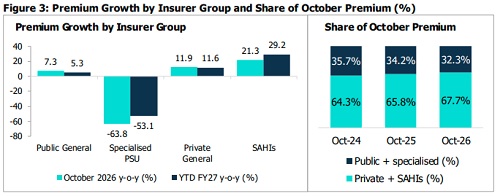

Premiums of specialised PSU insurers fell sharply in both the month and YTD FY27. The crop insurer in this group wrote Rs 16 crore in the month, against Rs 312 crore a year earlier, while the credit guarantee insurer's premium grew 30.5%. Two new insurers also began writing business in October, one in general insurance and one in health.
Health Premium Growth Slows to 16.1% Against a Comparable GST-Exempt Base
Health premium grew by 16.1% to Rs 14,428 crore in October, slower than 20.2% in September. Health accounted for 44.0% of total non-life premium in the month. Retail health slowed but still grew about twice as fast as group health.
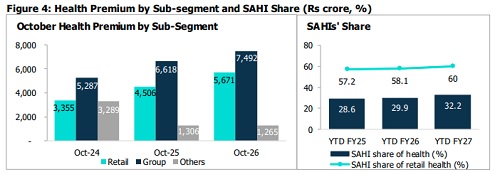
The GST exemption on individual health policies took effect on 22 September 2025, so October 2026 is the first month fully comparable with a period that already had the exemption. Retail health grew below 30% for the first time in FY27, after six months above that level. Last October was also a strong month, as buyers who had held back in September 2025 while waiting for the exemption returned to the market. Both effects pulled this month's growth rate down.
Retail health growth against a fully exempt base is a better guide to underlying demand than the rates of the past six months. It suggests that most of this year's retail health growth has come from more policies sold and higher cover taken, rather than from the tax change alone. Retail health growth should settle at a lower level from here, and the rate over the next few months will show how much of this year's growth reflects a lasting increase in demand.
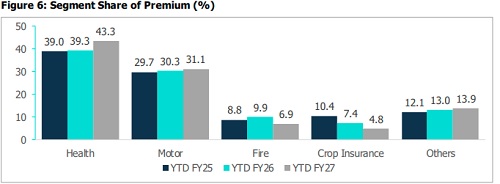
SAHIs gained further share of both health and retail health premium in YTD FY27. Their retail health premium grew 35.2% in YTD FY27, against 25.2% for general insurers. Group health is still written mainly by general insurers, who hold the corporate relationships, and remains the largest part of health. Its share of YTD health premium has fallen to 52.7% from 55.0% a year earlier as retail health grows faster. Government scheme and overseas medical premium, grouped as “others”, fell 3.1% y-o-y in October. This premium is booked in large instalments rather than evenly through the year, so monthly growth is not a reliable guide. YTD FY27 growth of 3.6% is the better measure.
Motor Premium Growth Slows to 6.5% as Diwali Moves to November Motor premium growth halved in October from September. Third-party premium grew faster than own damage for the first time this financial year, and own damage slipped to 42.3% of motor premium in the month, from 42.8% a year earlier.
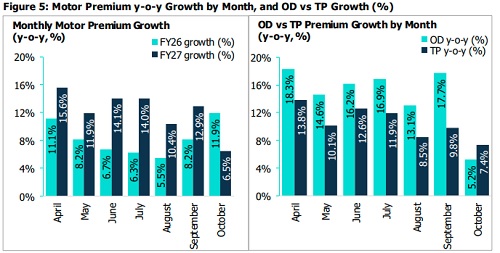
Dhanteras and Diwali fell in October last year and in November this year, so festive vehicle buying moved out of the month, and retail vehicle sales were lower than a year earlier. Last October also carried demand deferred from September 2025, when buyers waited for the GST rate cut on vehicles. October 2025 therefore had both the festive season and that deferred demand, so this October is compared against a high base.
Motor premium rose even though vehicle sales fell. New vehicles add to the motor book, but most of the premium written in any month comes from renewals on vehicles already insured, and third-party cover is compulsory for as long as a vehicle is on the road. A weak month for sales therefore slows the rate at which the book grows without reducing the book itself. TP rates have not been revised for FY27, so TP premium grows only with the number of vehicles insured. Motor premium growth should pick up in November as festive deliveries are recorded. However, higher financing costs after the repo rate increase in October remain a risk to demand.
Crop Premium Falls 7.5% in October and 29.5% in YTD FY27
Crop premium fell to Rs 846 crore in October, a much smaller fall than in September. October is a small month for crop, at 2.6% of the month's premium, as it sits between the Kharif and Rabi enrolment seasons.
The split between insurers has changed sharply. General insurers' crop premium grew in October, while the specialised public sector insurer has stepped back from the segment. For YTD FY27, general insurers' crop premium is almost unchanged, down 0.7%, while the specialised insurer's has fallen 60.6%. General insurers now write 73.1% of crop premium, against 51.9% a year earlier. Industry crop premium is down 29.5% in YTD FY27, and nearly all of that decline sits with the specialised insurer. Rabi enrolment runs through the next few months, and Bihar is returning to PMFBY from the Rabi 2026-27 season, which should support crop premium from November.
Fire Premium Returns to Growth, Rising 4.5% in October
Fire premium grew to Rs 1,907 crore in October, the first month of growth in FY27. The segment fell in every month from April to September, and the pace of that fall had been narrowing since July. Fire is still down 23.7% in YTD FY27, and its share of industry premium has fallen further. The turn to growth suggests the heavy discounting of the past year is easing. Large catastrophe losses during the monsoon usually feed into renewal pricing with a lag.
Public sector insurers' fire premium still fell 10.7% y-o-y in October, while the rest of the industry grew 12.7%. Across YTD FY27, the decline has been broad-based, with public sector fire premium down 25.3% versus 23.7% for the industry, pointing to a market-wide pricing cycle rather than business moving between insurers. January is the largest renewal month for fire cover and will determine its growth trajectory ahead.
Marine Leads Other Segments with 36.7% Growth in October
Marine was the fastest-growing segment in October, at 36.7% y-o-y, led by cargo at 47.3%. The domestic maritime insurance pool launched in May 2026 now covers war risk within India, so premium that used to be placed abroad is showing up in Indian figures. Aviation grew 20.8% in the month, liability 5.4% and engineering 1.7%. Personal accident premium fell 3.9%, the only segment apart from crop to decline. For YTD FY27, marine grew 33.5%, aviation 30.7%, personal accident 16.2%, liability 10.3% and engineering 8.3%.
CareEdge Ratings’ View
As per Priyesh Ruparelia, Director, CareEdge Ratings, “October’s headline growth reflects a lower base. Health contributed 44% to October premiums, and standalone health insurers wrote 60% of retail health cover this year. Retail health growth should settle at a lower level, now that the GST exemption period is fully comparable.”
Saurabh Bhalerao, Director, CareEdgeRatings, adds, “Three things matter for underwriting from here. Fire premium has grown for the first time in months, which suggests discounting is easing, and the January renewal season will show whether insurers keep pricing firm. In motor, the slowdown is mostly a festive timing effect and should reverse in November. However, third-party rates have now gone several years without revision while claims costs have risen, and that remains the key constraint on motor profitability. Crop is becoming a smaller business, written mostly by general insurers, who appear to be choosing their exposure more carefully than before.”
Above views are of the author and not of the website kindly read disclaimer