MoSPI Unveils India's First Index to Track Services Sector Output by CareEdge Ratings

The services sector has been a key driver of India’s economic growth. It comprises over 50% of India’s gross value added (GVA) and employs close to one-third of India’s workforce. Despite its importance, high-frequency indicators capturing the dynamics of this sector were limited to sectoral data such as air passenger/cargo traffic and railway passenger/ freight traffic, amongst others. The PMI Services serves as a gauge of activity in the overall services industry, but it does not capture the sector’s size or growth. The newly released Index of Services Production (ISP), published by the Ministry of Statistics and Programme Implementation (MoSPI), aims to bridge this broader gap in high-frequency measures of services sector activity and growth.
The ISP provides a systematic, timely and internationally aligned measure of short-term movements in service sector output, while ensuring consistency and comparability across time. It leverages GST and secondary and administrative datasets to estimate output indices for 19 sub-sectors, which collectively constitute 60% of services GVA. The compilation of the index excludes the sectors of public administration, other financial services such as central bank and money market funds, and other services due to coverage under different data sources. These sectors collectively account for 33% of the services sector GVA. MoSPI has stated that a single unified index capturing the entire services sector will be compiled once coverage increases closer to 80% of services GVA. Furthermore, weights given in the report by the Technical Advisory Committee are subject to revision going ahead
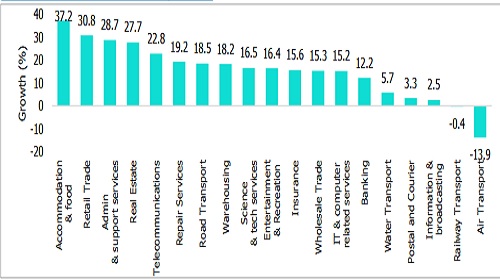
In April 2026, 14 out of the 19 sub-sectors recorded double-digit annual growth, and nearly all sub-sectors registered growth. Air transport services contracted by 13.9% YoY, compared to a growth of 4.5% in April 2025, underscoring the fact that geopolitical tensions have likely weighed on air traffic. Overall, the service sector benefits from steady domestic demand and healthy services exports.
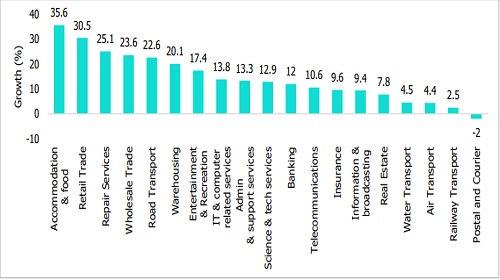
ISP Sub-Sector-wise Growth in FY26
ISP Sub-Sector-wise Growth in April 2026
Going forward, the introduction of the ISP marks a significant milestone in improving the measurement of India's services-led growth dynamics. Expanding sectoral coverage and improving data availability will be crucial for evolving the ISP into a comprehensive indicator of India's increasingly services-driven economy.
Key Features of the ISP Base Year & Scope
• The base year of 2024-25 has been chosen as a recent, structurally normal year and is broadly aligned with the new CPI series.
• ISP includes 19 sub–sectors for April 2026, representing about 60% of the services sector. Data Source
• GST-based data will be used for 15 sub-sectors, including Trade, Transport, Warehousing, Accommodation & Food, Postal & Courier, Telecom, Real Estate, IT, Professional/Technical Services, Arts & Entertainment, among others.
• Administrative data will be used for Railways (Railway Board), Air Transport (DGCA), Banking (RBI), and Insurance (IRDAI).
• Going forward, health & residential care, education, and ownership of dwellings will be added to the ISP.
• Coverage is restricted to the formal sector as GST and the Annual Survey of Incorporated Service Sector Enterprises (ASISSE) capture only GST/company-registered enterprises. The Annual Survey of Unincorporated Sector Enterprises (ASUSE) may eventually help through a separate quarterly GVA-based measure for the informal sector. Methodology
• Universe Approach is utilised as it captures the entire formal service sector rather than a representative sample and makes the index self-adjusting to the births and deaths of firms.
• Sub-sector-wise weights as per the Technical Advisory Committee report are provisional and are subject to revisions going forward. MoSPI has not yet compiled a single unified ISP.
Deflators
• At present, WPI is used as a deflator for wholesale trade, while for the other sub-sectors, either sub-sector-specific CPI has been used, or a suitable proxy CPI has been chosen.
• CPI – General has been used as a deflator for the sectors of Repair & Maintenance, Banking and Insurance. For the sectors where such mapping is unavailable, CPI-Services has been used as a deflator. Exclusions (around 33% of services GVA)
• Public administration and defence.
• Other financial services: Central bank, Pension/money-market funds.
• Other GST-exempt or largely informal services: Social work, Gambling/betting, Membership organisations, Personal services, Private households, Extraterritorial bodies.
Above views are of the author and not of the website kindly read disclaimer