Moong Report As On 17th September 2026 by Amit Gupta, Kedia Advisory

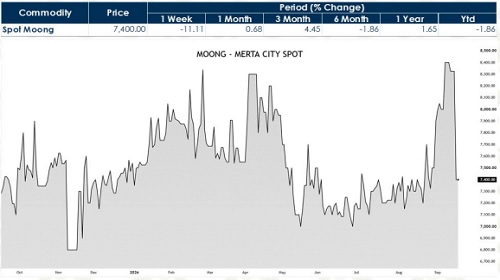
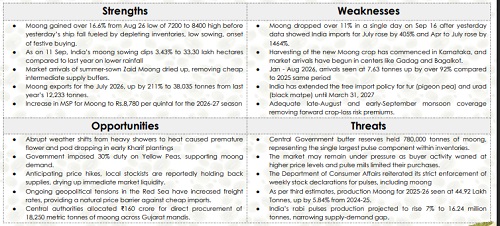
* Moong gained 16.6%, rising from Rs 7,200 to Rs 8,400 before 11% single-day correction.
* Moong sowing declined 3.43% to 33.30 lakh hectares by September 11.
* Summer Zaid Moong arrivals dried up, removing cheap intermediate supply buffers from markets.
* July 2026 Moong exports surged 211% to 38,035 tonnes year-on-year.
* Moong MSP increased to Rs 8,780 per quintal for the 2026-27 season.
* July Moong imports surged 405%, triggering an 11% single-day price decline.
* April-July Moong imports increased 1,464%, significantly improving near-term domestic supply availability.
* Jan-Aug 2026 arrivals increased 92% to 7.63 lakh tonnes year-on-year.
* Karnataka’s new Moong harvesting commenced, with arrivals emerging at Gadag and Bagalkot.
* Government imposed 30% Yellow Peas duty, supporting domestic Moong demand and substitution.
* Government allocated Rs 160 crore for procuring 18,250 tonnes of Moong across Gujarat.
* Central Government buffer stocks stood at 780,000 tonnes, largest pulse component held.
* Department of Consumer Affairs reinforced weekly stock declarations for Moong and other pulses.
* 2025-26 Moong production estimated at 44.92 lakh tonnes, increasing 5.84% year-on-year.
* Rabi pulses production projected 7% higher at 16.24 million tonnes, narrowing supply-demand gaps.
* Adequate late-August and early-September rainfall reduced forward crop-loss risk premiums.
* Free Tur and Urad imports extended through March 31, 2027, potentially improving pulse availability.
* Red Sea tensions increased freight rates, creating barriers against cheaper imported Moong supplies.
Haryana Moong Acreage Drops 41.8% to 85,815 Acres as Sowing Shifts to Oilseeds : Official state crop survey reports revealed that Haryana's moong acreage contracted sharply by 41.8%, falling from 147,650 acres in the preceding season to 85,815 acres. Farmers across southern and western districts shifted acreage toward groundnut and sesame following attractive cash returns and changing rainfall distributions. The state's agricultural department estimated total moong output at 34,326 metric tonnes, prompting state authorities to activate procurement arrangements across 38 designated market yards from October 1 to November 15.
Maharashtra Kharif Moong Sowing Declines Sharply Following Regional Rainfall Deficits : Final sowing updates for Maharashtra revealed a significant decline in kharif moong acreage across Marathwada and Vidarbha due to prolonged dry spells during key planting windows. Farmers substituted short-duration moong with soybean and cotton following uneven early monsoon rains, reducing the acreage footprint across Latur, Akola, and Jalgaon. Agronomists projected that aggregate state moong production could contract by 14.5% year-on-year, tightening supplies for domestic dal mills. Local wholesale yards registered quiet trading conditions as stockists held onto remaining summer crop inventories in anticipation of tighter supply balances.
Rajasthan Early Moong Harvesting Commences With Projected Output of 11.5 Lakh Tonnes : Early-stage kharif moong harvesting started across Nagaur, Bikaner, and Jodhpur, with preliminary trade estimates placing Rajasthan's total crop volume between 11.2 and 11.5 lakh tonnes. Scattered late-season rains across western desert tracts supported pod maturation, while modern hybrid seed varieties maintained average yields near 620 kg per hectare. Mandi arrivals reached 6,000 to 8,000 bags daily, with average spot bids opening between Rs 7,400 and Rs 7,900 per quintal based on seed luster and moisture levels.
Karnataka Moong Crop Yields Impacted by Erratic Rainfall and Dry Spells in Northern Belts : Agricultural field assessments across northern Karnataka, including Gulbarga, Bidar, and Yadgir, indicated a 12% reduction in average moong yields due to moisture deficits during flowering stages. Mandi arrivals in regional markets opened slower than usual, averaging 3,500 bags per day with moisture content averaging 14%. Millers reported that initial arrivals required sun-drying before processing, prompting spot discounts of Rs 200 to Rs 350 per quintal for wet lots.
Myanmar Green Mung Bean Export Offers Hold Steady at $840 Per Tonne FOB Yangon : Export quotations for FAQ-grade green mung beans from Yangon, Myanmar, held steady between $820 and $840 per metric tonne FOB over the past 30 days. Indian importers maintained regular container bookings to supply coastal processing clusters in Chennai and Kolkata, importing an estimated 16,000 tonnes over the month. Bilateral trade mechanisms utilizing local currency settlements helped bypass foreign exchange volatility, stabilizing landed import calculations. Myanmar exporters reported adequate warehouse stocks from their previous harvest, ensuring steady export container availability
Late-Monsoon Rains Across North-West India Elevate Harvest Moisture Concerns : Intermittent rainfall during early September across parts of Rajasthan, Punjab, and Haryana raised concerns regarding moisture content in mature standing moong crops. Agricultural extension scientists advised farmers to delay harvesting until pods achieve complete drying to avoid seed discoloration and fungal mold.
Above views are of the author and not of the website kindly read disclaimer