Insurance Distribution Reset: IRDAI Caps Distributor Pay-outs by CareEdge Ratings

Synopsis
• A reset, not a tweak. IRDAI's September 23, 2026 consultation paper proposes the deepest overhaul of insurance distribution since the 2016 expense rules: hard, all-inclusive commission caps by product and channel, expense ceilings that tighten over five years from FY28, and one three-tier licensing framework for every intermediary. Comments are due by October 25, 2026.
• Why now: costs have shot up. Between FY23 and FY25, commissions grew two to eight times faster than the premium they were paid on. Private general insurers now spend 32.1% of premium on expenses, more than in FY15. Yet fewer than half of life policies survive to their fifth year, and grievances in general insurance have risen by 75%.
• Intermediaries are the biggest losers. At current volumes, large distributors’ pay-outs could shrink significantly. Banks with multiple insurer tie-ups, motor dealers and retail brokers also face steep cuts.
• Most insurers must cut costs sharply. 20 of 22 life insurers and 28 of 31 general insurers are above the proposed FY29 expense ceiling. Policyholders gain along with large insurers, tied agents, and digital channels. Sub-scale insurers face a choice between deep cost cuts, fresh capital or consolidation.
• What to watch: how far the final caps soften after industry feedback, whether IRDAI moves towards customer-paid fees, and a likely rush of sales before FY28 followed by a dip in new business.
IRDAI Returns to Hard Limits
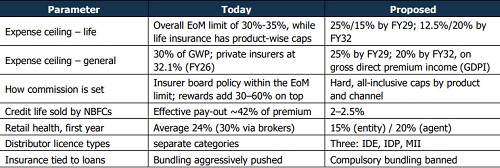
Commission rules in Indian insurance have shifted between strict and relaxed. In 2016, IRDAI introduced productwise commission caps alongside limits on total management expenses (EoM), and expense ratios fell over the next few years. In 2023, it reversed this approach. Product-wise caps were removed, and each insurer’s board was allowed to set its own commission policy, provided total expenses remained within an overall limit (for general insurers, 30% of gross written premium (GWP); 35% for standalone health insurers, while life insurers operate under product-level caps). The goal was to give insurers more freedom to invest in growth. The consultation paper, released in two parts (the diagnosis and proposals in Part 1, the supporting data in Part 2), concludes that insurers mostly used this flexibility to pay distributors more. In IRDAI’s words, the sector has become “high cost and commission-led”. The regulator now proposes returning to strict limits, with tighter rules on what counts as commission, so payments cannot be reclassified to avoid the caps.
Growth Has Come from Existing Customers, Not New Ones
From FY15 to FY25, nominal GDP grew 2.6 times, life premium 2.7 times, and general premium 3.4 times. On the surface, this looks healthy, but coverage has not expanded. The number of individual life policies sold each year has remained flat for a decade, and insurance penetration stood at 3.7% of GDP in FY25, compared with 3.3% in FY15. The market is also concentrated: the two largest life insurers hold 65% of premium, and the ten largest general insurers hold 68%. Many remaining players lack the scale to operate efficiently, pushing them to buy business by paying higher commissions
Figure 1: The Reform Snapshot – Today vs Proposed
Expense Discipline Has Come Full Circle
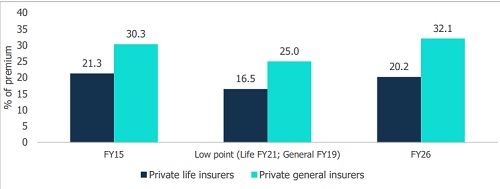
Private life insurers managed to cut their expense ratio from 21.3% in FY15 down to 16.5% by FY21, though that last year was skewed by the pandemic. Since then, costs have crept back up, hitting 20.2% in FY26. General insurers fared worse. Their ratio dropped from 30.3% to around 25% by FY19 but has since climbed to 32.1%, actually higher than where it started. Size matters, too. The biggest players run lean: they spend roughly 10–15% of premiums (life) and 20–25% (general) on operations. Smaller insurers, by contrast, shell out about 22% and 29% respectively and the least efficient ones burn through as much as 39% and 48%.
Figure 2: Private Insurers' Total Expense Ratio (% of Premium)
Commissions Outran Premiums by Two to Eight Times
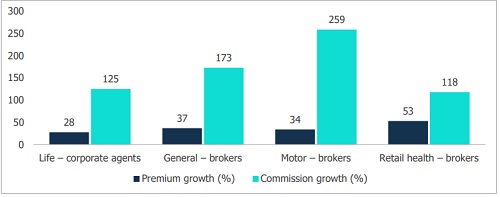
In the two years since the 2023 reforms, payouts to distributors have outpaced the actual business they’re bringing in. Take motor insurance through brokers: commissions shot up 259%, while premiums grew just 34%. That’s nearly eight times faster. Life corporate agents saw a similar pattern as commissions jumped 125% on 28% premium growth, with payouts now accounting for about 27% of first-year premiums. Across general insurance, the average broker commission doubled from 8.5% to 17% of premium. cover. Motor third-party average commission surged from 4.3% to 22%. And that’s just the card rate. Throw in rewards, bonuses, and other incentives, and the real cost of distribution is way higher than what the rate cards suggest.+
Figure 3: Cumulative Growth in Premium vs Commission of brokers and corporate agents, FY23–FY25 (%)
The Incentives Reward Selling, Not Keeping Policies
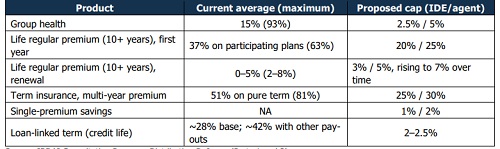
How commission is structured matters as much as how much is paid. In life insurance, payments are heavily focused on the first year. Pure term policies pay an average of 51% of the first-year premium (up to 81%), but renewal commission is close to zero at 0–5%. This means a distributor earns almost everything at sale and very little for keeping the policy active. In general insurance, for group health—where large employers should have the bargaining power to pay less—commissions have been as high as 93%, above the 70% peak in retail health.
Customers Have Paid More but Received Less
High distribution costs, rising premiums, and ongoing claims-related complaints raise concerns about policyholder outcomes. Only 48% of life policies are still active by the 61st month. The difference between sales channels is clear: 71% of policies sold online survive to the fifth year, compared to just 43% of those sold through corporate agents like banks and NBFCs. At the weakest insurer, only 8% of policies reach their tenth year. When policies end early, customers lose money. General insurance shows similar strain. In general insurance, complaints rose from 78,347 in FY23 to 1,37,361 in FY25, with nearly 69% of general insurance complaints on the Bima Bharosa portal related to claims. Health insurers paid out an average of 75% of the claim amount, with a wide range of 29% to 94% across insurers
The Proposals: Four Pillars
Pillar 1: One Framework for All Distributors The many existing licence types, each with its own rules, will be folded into three:
• Insurance Distribution Entities (IDEs): all incorporated distributors, including banks, NBFCs, brokers, web aggregators and motor dealers. IDEs may sell for any number of insurers.
• Insurance Distribution Persons (IDPs): individuals, including agents, associates, specified persons, and Point of Sale Persons (PoSPs). Agents stay tied to one insurer per segment.
• Market Infrastructure Institutions (MIIs): not-for-profit digital platforms such as Bima Sugam, owned by groups of insurers. Entry becomes easier, but conduct rules become stricter. The minimum capital for an IDE drops to Rs. 10 lakhs, with a deposit of 0.1% of insurance income (minimum Rs. 10 lakh, maximum Rs. 10 crores). Registration becomes permanent, with an annual fee of Rs. 10,000 or 0.04% of receipts, whichever is higher. All distributors may also sell non-insurance products, and hospitals and garages can join the distribution chain. Surveyors and third-party administrators (TPAs) are barred from selling. Individual sellers will need Class 12 qualification and 100 hours of training per segment.
Pillar 2: Lower Expense Ceilings over Five Years
Figure 4: Expense of Management (EoM) Glide Path, % of Premium

IRDAI is also closing the routes insurers have used to flatter their expense ratios. For general insurers, three changes will raise reported costs even if actual spending stays the same:
• EoM to be measured against GDPI instead of GWP, so reinsurance accepted no longer inflates the base.
• Reinsurance commission received can no longer be netted off against expenses.
• Existing carve-outs for technology and rural business will count within the limit.
Crop insurance, i.e. Pradhan Mantri Fasal Bima Yojana (PMFBY) premium, will count at only one-third, ending its use as a cheap way to dilute the expense ratio. Every insurer will need a cost audit, as will IDEs with revenue above Rs. 100 crores. Insurers that miss their targets face curbs on new products, dividends or distribution channels. The annual regulatory fee falls from 0.05% to 0.04% of premium, capped at Rs. 20 crores.
Pillar 3: Hard, All-Inclusive Commission Caps
The caps cover every payment to a distributor, whatever it is called: commission, rewards, brand fees or outsourcing charges. Four principles shape them. Distributors who can choose between insurers (IDEs) get lower caps than tied agents. Mandatory products earn nil or near-nil commission. Nil TP commission may weaken TP distribution and renewals (increase in uninsured vehicles). As companies do not set up TP premium, savings accrue to insurers unless the tariff is revised. Group and renewal business earn less than new individual business. Sales in underserved areas earn a bonus of 10% or 20% of the commission on top of the cap. Point of Sales Persons (PoSPs) are paid out of their IDE's share, not in addition to it.
Figure 5: Current Commission vs Proposed Caps, % of Premium

Above views are of the author and not of the website kindly read disclaimer











Tag News
All you need to know about IRDAI's proposed reforms to clean up insurance sector