Indian Real Estate Attracts USD 1.1 bn in PE Investment in H1 2026; Office Lead with 89% Share of Investment: Knight Frank India

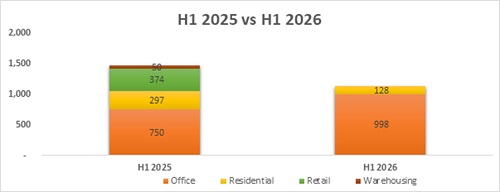
Knight Frank India, the leading international property consultancy, in its latest report Trends in Private Equity Investment in India: H1 2026, records that private equity (PE) investments in Indian real estate totaled USD 1.13 bn during H1 2026, marking a 23% year-on-year (YoY) decline from USD 1.47 bn recorded in the same period last year. Office continued to remain the preferred asset class for investment with 89% of PE investment in H1 2026, while residential sector received the remaining. National Capital Region (NCR) recorded maximum investment amongst the top eight[2] cities of India.
The moderation in investment activity reflects more selective capital deployment amid elevated global interest rates, tighter financial conditions, and heightened geopolitical uncertainty. Importantly, the report underscores that this decline does not signal any weakening of India’s real estate fundamentals. Rather, it points to an evolving global investment landscape, where institutional investors are increasingly prioritizing risk-adjusted returns, liquidity, and execution certainty overgrowth potential alone.
PE Investments by Asset Class - H1 2026
International investors evaluate opportunities relative to the return available from risk-free assets. During 2020-21, the yield gap between India's 10-year government bond and the US 10-year Treasury was approximately 440 basis points, creating a substantial risk premium that supported capital allocation into emerging markets. However, by H1 2026, this spread had narrowed to around 240 basis points, nearly half the level seen during the pandemic period. As US Treasury yields rose from approximately 1.8% in 2021 to around 4.4% in H1 2026, investors could earn significantly higher returns from low-risk assets in developed markets. Consequently, India now competes not only on growth potential but also on the efficiency with which returns are generated, protected and ultimately realised.
Higher Global Interest Rates Reshape Capital Allocation Decisions
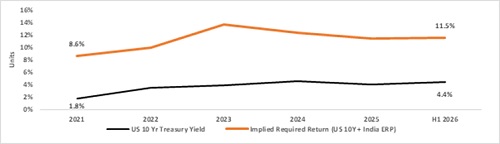
The impact of higher global interest rates extends beyond yield differentials and directly influences investment hurdle rates. During the low-rate environment of 2020-21, investors could achieve their target returns even when spreads above the risk-free rate were relatively modest. With US Treasury yields at approximately 1.8%, an implied required return for India was around 8.6%. By H1 2026, however, the average US Treasury yield had increased to approximately 4.4%, pushing implied required returns for Indian investments to nearly 11.5%. This represents a substantial increase in the minimum return threshold required for capital deployment.
Required Returns Have Increased Materially Since 2021
As a result, risks that were previously manageable now have a far greater impact on investment decisions. Currency depreciation, taxation, project delays, construction risks, leasing uncertainty and exit execution can materially affect whether an investment clears the required return threshold.
NCR leading destination for PE Investment in H1 2026
Investment activity remained concentrated in a handful of established markets that offer strong occupier demand, quality asset pipelines and greater visibility of returns. NCR emerged as the leading destination for private equity investments in H1 2026, recording a remarkable 522% YoY increase in inflows to USD 411.1 mn, compared with USD 66 mn in H1 2025. Accounting for over one-third of total PE investments during the period, the region's strong performance was driven by a balanced mix of office and residential transactions, ongoing infrastructure expansion, a growing corporate occupier ecosystem and a deep pipeline of institutional-grade assets. These factors have reinforced NCR's position as a preferred investment destination amid an increasingly selective capital environment.
Pune followed with USD 355.9 mn of investments, supported by selective residential transactions and its growing position as an office and manufacturing hub, while Chennai attracted USD 154.7 mn, benefiting from strong industrial, logistics and commercial real estate fundamentals. Bengaluru recorded USD 115.9 mn of investments, underpinned by sustained GCC expansion and its position as India's leading technology and office market. Mumbai attracted USD 84.3 mn, reflecting continued investor interest in India's financial capital despite elevated asset pricing, while Hyderabad recorded USD 4.3 mn amid a more measured pace of capital deployment.
|
PE investments received across major Indian cities in H1 2026 (USD mn) |
|||
|
City |
Residential |
Office |
Total |
|
NCR |
47.3 |
363.8 |
411.1 |
|
Pune |
47.1 |
308.8 |
355.9 |
|
Chennai |
- |
154.7 |
154.7 |
|
Bangalore |
- |
115.9 |
115.9 |
|
Mumbai |
29.7 |
54.6 |
84.3 |
|
Hyderabad |
4.3 |
- |
4.3 |
|
Total |
128.2 |
997.8 |
1126 |
Shishir Baijal, International Partner, Chairman and Managing Director, Knight Frank India, said, "The moderation in private equity investments during H1 2026 is largely a reflection of the evolving global capital environment rather than any deterioration in India's real estate fundamentals. Over the past few years, investors have witnessed a sharp rise in global borrowing costs, reducing the yield advantage that emerging markets traditionally enjoyed. Consequently, capital allocation decisions are increasingly influenced by factors such as execution certainty, taxation, liquidity and realised returns. Despite these challenges, India's office market continues to demonstrate remarkable resilience, supported by sustained GCC expansion, strong occupier demand and an increasing stock of institutional-grade assets. Looking ahead, India's long-term growth story remains compelling, but attracting larger pools of global capital will increasingly depend on creating a competitive investment framework that complements strong market fundamentals."
Office sector emerges as the preferred investment destination
The office sector was the strongest-performing asset class during H1 2026, accounting for nearly 89% of all PE investments in Indian real estate. Investments in the segment rose by 33% to USD 998 mn, compared with USD 579 mn during H1 2025.
The sector continues to benefit from robust occupier demand led by Global Capability Centres (GCCs), multinational corporations and domestic enterprises. India's large skilled workforce, cost competitiveness and increasing strategic relevance in global corporate operations continue to support leasing momentum across major office markets.
PE investments received across India in Office Sector
|
City |
Investment (USD mn) |
|
NCR |
363.8 |
|
Pune |
308.8 |
|
Chennai |
154.7 |
|
Bangalore |
115.9 |
|
Mumbai |
54.6 |
|
Total |
997.8 |
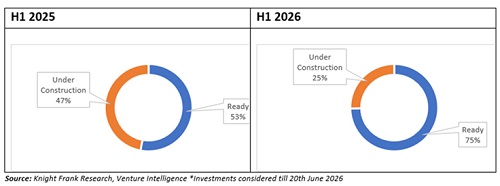
Investor preference was overwhelmingly skewed towards ready office assets during H1 2026, with completed properties accounting for approximately 75% of total office investments, up from 53% in H1 2025. The sharp increase underscores the ongoing shift in global capital allocation strategies amid higher interest rates and elevated hurdle rates. As the yield advantage historically enjoyed by emerging markets narrows, investors are increasingly prioritising assets capable of generating immediate and predictable cash flows. Ready assets offer greater income visibility, lower execution risk and faster capital deployment, making them particularly attractive in an environment where financing costs, taxation, currency movements and exit certainty play a larger role in determining investment returns.
75% of the investments is in Ready assets
Residential sector witnesses’ selective capital deployment
Private equity investments in the residential sector declined from USD 297 mn in H1 2025 to USD 128 mn in H1 2026, as investors adopted a more cautious and selective approach towards development-led opportunities.
PE investments received across India in Residential Sector
|
City |
Investment (USD mn) |
|
NCR |
47.3 |
|
Pune |
47.1 |
|
Mumbai |
29.7 |
|
Hyderabad |
4.3 |
|
Total |
128.4 |
The moderation comes despite healthy underlying housing market fundamentals. Residential real estate continues to benefit from increasing formalisation, stronger balance sheets among leading developers and sustained end-user demand across key markets. However, higher financing costs and stricter return expectations have led investors to focus on opportunities offering stronger risk-adjusted returns.
PE investments in residential sector
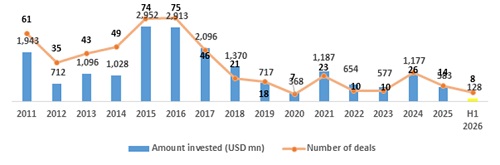
Debt instruments accounted for a significant share of capital deployed during the period, highlighting investor preference for structured investments with greater downside protection. NCR, Pune and Mumbai collectively accounted for the majority of residential sector investments during H1 2026.
Warehousing and retail fundamentals remain intact despite investment pause
The warehousing and retail sectors did not witness any major PE transactions during H1 2026. However, Knight Frank India notes that the absence of transactions does not indicate a decline in the attractiveness of these asset classes.
Outlook
India's long-term real estate fundamentals remain firmly intact, supported by rapid urbanisation, economic expansion, growing institutionalisation and a steadily expanding stock of investment-grade assets. While global capital flows are expected to remain selective in the near term, sectors backed by strong occupier demand, stable income profiles and transparent governance frameworks are likely to continue attracting investor interest.
The next phase of capital inflows into Indian real estate will be driven not only by growth prospects but also by the country's ability to deliver predictable post-tax, risk-adjusted returns. Policy initiatives that enhance the competitiveness of India's investment ecosystem and facilitate long-term institutional participation could play a crucial role in strengthening capital flows into the sector over the coming years.
Above views are of the author and not of the website kindly read disclaimer