India's Growth Story Holds Firm as Oil, Currency and Fed Uncertainty Test Market Nerves: PL Wealth

PL Wealth's latest Market Outlook – July 2026 report finds that India's underlying economic engine is running steady even as crude prices, a softer rupee and persistent foreign selling create near-term turbulence, pushing the firm to recommend a more selective, quality-first approach to equities.
The report points to a provisional FY26 GDP print of 7.7%, with the RBI now penciling in a slower 6.6% for FY27. June 2026 manufacturing and services activity, tracked via PMI readings of 54.2 and 57.4, moderated slightly from May but stayed well within expansion. Credit growth to businesses and households held up at 17.7% YoY, taking the outstanding book to Rs 215.15 trillion, while factories ran at 75.2% capacity utilisation, ahead of long-run norms.
At the same time, the report flags a meaningful uptick in inflation risk: the RBI has lifted its FY27 CPI estimate to 5.1%, with a projected Q3 spike to 5.9%. Persistently high crude, unresolved tensions in West Asia, and a rupee that has structurally weakened toward the 94.5–95 mark against the dollar are all cited as reasons markets could stay choppy in the months ahead — reinforcing the report's call for investors to be discerning rather than broad-based in their positioning.
Speaking on the findings, Inderbir Jolly, CEO, PL Wealth, noted: “India is entering FY27 from a place of comparative strength, but that shouldn't be mistaken for calm — oil, the rupee and an unpredictable Fed under new leadership are all live risks. The RBI has paused, yet markets haven't; this calls for investors to prioritise quality and staying power over chasing the broader index. Nothing about the past quarter changes our medium-to-long-term conviction on India, which continues to rest on demographics, domestic investment and deepening financial markets.”
Macro Environment
In June, the RBI’s rate-setting panel adopted a more cautious tone, holding the repo rate at 5.25% while raising its inflation forecast and lowering its growth estimate—a combination the report describes as a “higher-for-longer” stance. India’s external buffer remains sizable, with forex reserves of USD 667 billion covering roughly 10.5 months of imports. GST collections for June 2026 climbed 13.9% YoY to Rs 1.95 lakh crore, the best monthly figure in over a year, buoyed by strong import-linked collections. Trade-wise, pacts with the UK, New Zealand, EFTA and Oman are now in force, the EU FTA is awaiting sign-off, and talks on a bilateral trade deal with the US remain ongoing. The report also calls out the monsoon as a watch item, with El Niño conditions in place and June rainfall tracking roughly 40% below the seasonal norm.
Market Valuation & Positioning
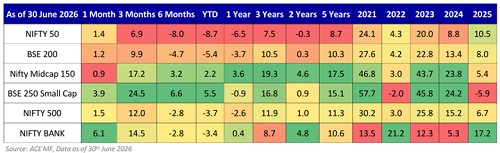
PL Wealth observes that near-term earnings estimates continue to face downward pressure, with FY27 profit forecasts being trimmed across banking, consumption, infrastructure, pharmaceuticals and utilities — even as FY28 numbers are proving more resilient. While participation across mid- and small-cap stocks has widened over the last six months, the report notes that the rally is still being led by a narrow set of sectors rather than the market as a whole. The Nifty 50 closed at 23,946 at the end of June 2026, down 6.5 per cent year-on-year. Consistent buying by domestic institutions helped soften the impact of ongoing selling by foreign investors.
Equity Markets – An Overview and Approach
PL Wealth remains constructive on Indian equities over the long run, pointing to the country's demographic profile, rising domestic investment, a deepening financial system, diversifying supply chains and improving energy security as the pillars of that view
Short Term (0 to 6 months): Expect a range-bound market shaped by energy prices, rupee movement and earnings surprises. The report favours a phased entry into quality large-cap and large & mid-cap names over lump-sum deployment.
Medium Term (6 to 24 months): As oil-driven pressures fade and inflation tops out, attention should shift to domestic demand drivers — financial-asset penetration, infrastructure build-out and manufacturing localisation — with room to add large private banks, industrials, healthcare, and select small-cap and flexi-cap exposure.
Long Term (24 to 60 months): The report keeps its overweight call on India intact, anchored in demographics, domestic capital spending, financial deepening and energy security, with mid-caps, small-caps and infrastructure-linked themes as preferred building blocks for SIP-based investors.
Fixed Income Outlook
On debt markets, the report describes a shift in focus — from riding the tailwind of earlier rate cuts to actively managing duration risk. The 10-year government bond yield, which had risen toward 7.1% earlier in the year on the back of costlier crude, has since eased to close to 6.9% by end-June as oil corrected and foreign investors returned to Indian debt following recent liberalisation steps. PL Wealth sees the best risk-adjusted returns currently in the short end of the curve (3 months to 3 years), views the 5–8 year segment as a tactical add, and would only extend into longer maturities on sharp yield spikes, given ongoing crude and monsoon-related uncertainty.
Outlook for Commodities
Gold's transition from a currency hedge to a core reserve asset remains on track, the report says, notwithstanding its steepest quarterly drop since 2013 — prices slid to roughly USD 3,940–4,044/oz by end-June before climbing back to the USD 4,150–4,180/oz band in early July on a weaker US jobs print. PL Wealth expects gold to trade broadly within a USD 3,900–4,400/oz band near-term, with ongoing central-bank purchases acting as a floor. Silver is likely to stay choppy, holding in the USD 60–65/oz zone, with any decisive breakout hinging on a revival in investment-led demand.
Above views are of the author and not of the website kindly read disclaimer