India`s Clean Fuel Transition Opens Rs1 Lakh Crore Biogas Opportunity: smallcase manager
According to the latest report by Karthick Jonagadla, smallcase manager & MD and CEO Quantace Research, India’s growing dependence on imported crude oil is emerging as one of the country’s biggest structural economic vulnerabilities, while biogas and compressed biogas (CBG) are increasingly being viewed as a viable domestic solution capable of reshaping the nation’s energy landscape over the coming decade.
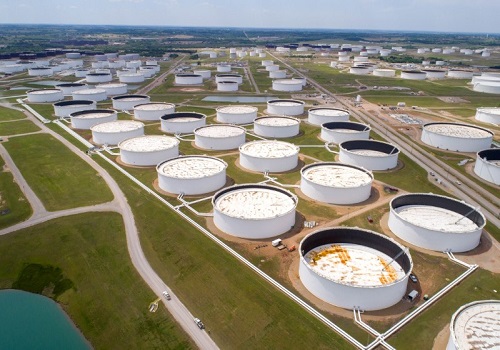
India’s crude import dependence has climbed steadily over the past decade and touched a record 89.4% in FY25, while the country’s petroleum import bill is estimated at nearly USD 143 billion. The rising reliance on imported fuel, coupled with recurring geopolitical disruptions and volatile crude prices, is intensifying concerns around energy security, inflation, and the broader macroeconomic outlook.
Industry experts believe the country is now entering a phase where alternative domestic fuel ecosystems are becoming strategically important rather than remaining peripheral clean-energy themes.

Industry experts believe the country is now entering a phase where alternative domestic fuel ecosystems are becoming strategically important rather than remaining peripheral clean-energy themes.
“India’s energy vulnerability is no longer cyclical — it is structural,” said Karthick Jonagadla , smallcase manager & MD and CEO Quantace Research. “Domestic oil and gas production continue to stagnate even as demand rises steadily, leaving the economy increasingly exposed to global crude shocks, imported inflation, and external geopolitical risks. Biogas represents one of the few scalable and immediately deployable domestic alternatives available to India.”
Unlike several clean-energy technologies that remain dependent on imported equipment, minerals, or overseas supply chains, India’s biogas opportunity is built almost entirely on domestic resources. The country’s vast agricultural economy, large cattle population, and growing urban waste generation provide a uniquely localized energy resource base that few major economies possess.
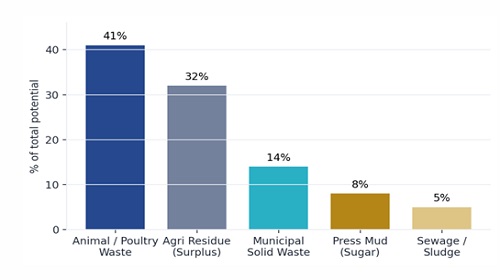
Agricultural residue, cattle waste, municipal solid waste, and industrial byproducts are increasingly being viewed not merely as waste streams, but as strategic energy assets capable of reducing India’s dependence on imported hydrocarbons. Industry observers believe this gives biogas a unique advantage within the broader energy-transition landscape because it directly links energy security with waste management and rural income generation.
Despite possessing one of the world’s largest agricultural and organic waste bases, India has only begun scratching the surface of its biogas potential. The country’s theoretical CBG production capacity is estimated at 62 million metric tonnes annually, while current production remains below 1% of this potential, leaving a massive untapped domestic energy opportunity.
India generates over 500 million tonnes of agricultural residue annually and has one of the world’s largest cattle populations, creating a substantial feedstock base for biogas production. Much of this material currently remains underutilized or contributes to environmental challenges such as stubble burning and landfill accumulation.
Industry participants increasingly believe biogas could evolve into a “homegrown energy hedge” for India at a time when global fuel supply disruptions are becoming more frequent and energy security concerns are intensifying worldwide.
Policy momentum is also beginning to strengthen.
The government’s SATAT (Sustainable Alternative Towards Affordable Transportation) initiative and the recently introduced mandatory CBG blending roadmap are expected to become major catalysts for the sector. As of early 2026, over 130 CBG plants had been commissioned under SATAT, while more than 1,000 projects remain in the pipeline. Mandatory blending obligations are set to rise gradually over the next few years, creating long-term demand visibility for producers and infrastructure developers.
The transition from voluntary adoption to mandatory blending is widely seen as a turning point for the sector because it creates predictable demand and improves commercial viability.
Achieving the planned blending targets will require substantial investments across biogas plants, logistics systems, feedstock aggregation infrastructure, and city gas distribution integration. Industry estimates suggest the broader sectoral opportunity could attract investments of nearly Rs1 lakh crore over the next several years, making it one of the emerging themes within India’s clean-energy infrastructure space.
“The transition from policy encouragement to mandatory blending changes the economics of the sector meaningfully,” Jonagadla said. “Demand visibility improves significantly, which allows infrastructure developers, technology providers, and institutional investors to participate with greater confidence.”
Recent policy interventions such as excise duty waivers on CBG blended with CNG and upward revisions in procurement pricing are also expected to improve project viability and accelerate private-sector participation. The emerging opportunity extends well beyond standalone biogas producers and spans multiple segments of the energy and infrastructure ecosystem.
Oil marketing companies are expected to play a central role as both off takers and developers of CBG infrastructure. Companies such as Indian Oil Corporation Limited, Hindustan Petroleum Corporation Limited and Bharat Petroleum Corporation Limited are increasingly investing in biogas projects and long-term supply networks. Gas utilities and city gas distribution companies are also likely to benefit as blending requirements expand and pipeline integration improves.
Technology and EPC players specialising in bioenergy systems are expected to emerge as early beneficiaries during the sector’s infrastructure build-out phase. Among listed companies, Praj Industries is viewed as one of the more direct plays on India’s bioenergy transition due to its presence in ethanol and CBG technologies.
Above views are of the author and not of the website kindly read disclaimer
The sugar and distillery ecosystem could also see increased participation, particularly through the utilisation of press mud as feedstock. Waste management companies and dairy cooperatives may similarly emerge as important participants within the broader supply chain.
Beyond energy security, the sector is also expected to create meaningful rural economic benefits.
Large-scale deployment of biogas infrastructure could create employment opportunities across plant construction, operations, logistics, and organic fertiliser production, while also generating supplementary income streams for farmers and rural entrepreneurs. Industry estimates indicate that large-scale scaling of the sector could support tens of thousands of direct and indirect jobs over the coming decade.
Industry projections suggest that replacing even a modest share of India’s natural gas consumption with domestically produced biogas could materially reduce LNG imports over the coming years, helping strengthen the country’s external balance while improving long-term energy resilience.
Challenges, however, remain substantial.
Feedstock supply chains continue to be fragmented, biomass availability is seasonal in many regions, and financing smaller projects remains difficult due to high upfront capital costs. Faster expansion of city gas distribution networks and more stable long-term pricing frameworks will also be critical to improving project bankability.
India’s ethanol blending journey has already demonstrated how rapidly alternative fuel ecosystems can scale once policy support, infrastructure, and commercial incentives begin aligning. Industry observers increasingly believe CBG may now be approaching a similar early-stage inflection point.
As India attempts to reduce its exposure to volatile global energy markets while simultaneously addressing waste management and rural income generation, biogas is steadily transitioning from a policy-driven initiative into a commercially significant energy opportunity.
Above views are of the author and not of the website kindly read disclaimer