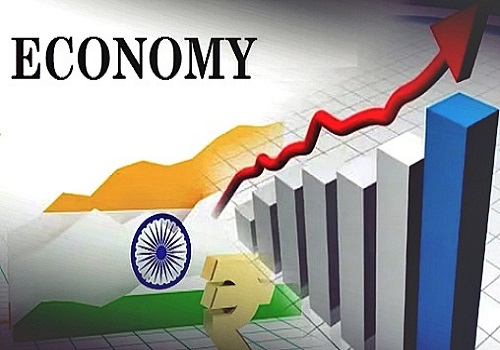
GDP Preview Q2 FY27: GDP Growth Projected at 7.6% by CareEdge Ratings

Q2 FY27: Economy Sails Through Choppy Waters
Q2 FY27 (July – September 2026) witnessed continued geopolitical uncertainty and supply chain pressures on energy prices. While crude oil prices were volatile, prices of crude-derived fuels, particularly diesel, also increased, as attacks on refineries in West Asia and Russia squeezed production of these fuels. The price pressures fed into inflation across economies and necessitated policy rate hikes by major central banks. Despite these challenges, global economic growth is expected to hold up relatively well at 3.1% in 2026, as per the IMF’s World Economic Outlook (October 2026), albeit slower than 3.5% in 2025.
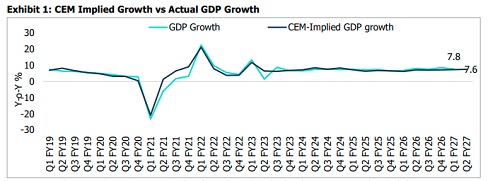
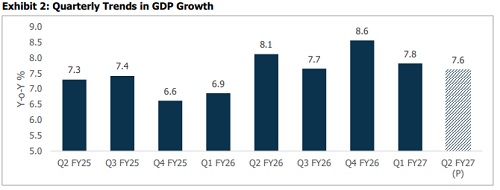
India’s economy has navigated through these choppy waters well. High-frequency macroeconomic indicators like IIP, core sector, auto sales, exports and power consumption have shown steady growth. Bank credit growth has also been strong. Furthermore, corporate sector performance has remained healthy in Q2. Our analysis of a sample of 1600 listed non-financial companies shows that both revenue and profitability have been robust, growing by over 20% y-o-y in Q2 FY271. Given the robust high-frequency macroeconomic indicators and healthy corporate performance, we expect GDP growth in Q2 FY27 to hold steady at 7.6% y-o-y, compared to 7.8% in the previous quarter.
CareEdge Economic Meter Projects GDP growth at 7.6% in Q2 FY27 The CareEdge Economic Meter (CEM), based on more than 30 high-frequency indicators (HFIs), estimates India’s GDP growth at 7.6% in Q2 FY27, marginally lower than the 7.8% recorded in Q1 FY27. Gross Value Added (GVA) growth is estimated at 7.7% in Q2 FY27, compared with 8.2% in the preceding quarter. The GVA growth could marginally outpace GDP growth primarily due to a likely contraction in net indirect taxes. Overall, growth in Q2 FY27 is expected to be supported by healthy momentum in manufacturing and financial, real estate and professional services (FREPS). However, subdued agricultural performance and a deceleration in trade, hotels, transport, communication and broadcasting-related services (THTCS) are likely to weigh on overall economic growth.
Sectoral Performance
Agriculture
The Southwest monsoon in 2026 recorded its weakest performance in a decade, with a 13% rainfall deficit and spatial unevenness. At the national level, while area under kharif sowing was lower only marginally by 1% (y-oy), agricultural yields will be important in determining the actual output. Karnataka, Maharashtra, Andhra Pradesh, Telangana, Rajasthan and Gujarat have declared drought in multiple districts. The government has also set an agricultural output (crop year July 2026 – June 2027) target of 373.9 million tonnes, down 2.6 million tonnes from last year’s output. HFIs relating to the agricultural sector present a mixed picture. Domestic tractor sales declined by 3.1% in Q2 FY27, following a strong growth of 18.6% in the previous quarter. Outstanding agricultural credit rose by 18% y-o-y. Reflecting these conditions, we expect agricultural growth to moderate to 0.8% y-o-y in Q2 FY27, from 3.6% in the previous quarter.
Manufacturing Sector
Manufacturing sector HFIs have mostly improved compared to the previous quarter. Volume of output in the manufacturing sector, as measured by the IIP manufacturing index, grew by 8.1% (y-o-y) in Q2 FY27. The impact of last year's GST rate rationalisation continued to play out in the second quarter, with automobile production, passenger vehicle sales and 2-wheeler sales growing robustly by 18%, 30.6% and 15.4% (y-o-y), respectively. However, expansion in steel production was subdued at 3.3%, partially explained by an adverse base effect.
India’s exports recorded robust growth, partially supported by currency weakening. Growth in core exports (nonoil, non-gold exports in USD terms) surged by 19.7% in Q2 FY27 from 12.7% in Q1 FY27, while exports of oil and oil products grew by 52.6%. India’s refinery capabilities and capacities, combined with the rising global prices of refined petroleum, led to the sharp rise in petroleum exports.
Input price pressures driven by higher energy and metals prices have begun to feed into the production process, reflected in the elevated producer price index inflation of 11.4% in Q2 FY27. However, given the recent correction in commodity prices, input price pressures are likely to moderate going forward. Considering these developments, we expect manufacturing GVA to increase by 9.2% y-o-y in Q2 FY27, the same pace as in Q1 FY27.
Mining and Utilities: The contraction in mining and quarrying activity, as measured by the IIP-Mining & Quarrying, deepened further in Q2 FY27 to 3.1% from a decline of 1.2% in Q1 FY27. This was mostly due to an adverse base effect from Q2 FY26 when growth was high at 14%. However, the sector saw some support from rising exports of ores and minerals, which rose 24.6% in Q2 FY27 y-o-y. We project mining & quarrying GVA to decline by 4.4% in Q2 FY27, a larger contraction compared to (-)2.4% in Q1 FY27.
The expansion in utilities is likely to come on the back of healthy growth in power generation and demand. Electricity demand rose by 11.1% in Q2 FY27, driven by poor rainfall, higher temperatures during the quarter and healthy economic activity. While electricity generation followed suit, growing by 8.5%, there was a rise in electricity deficit due to lower supply from hydropower sources on account of uneven and inadequate rainfall. Moreover, the solar power buildout is managing daytime loads, but, in the absence of adequate battery storage and grid flexibility, is causing a demand-supply mismatch in the evening/nighttime, when power demand peaks. We expect Electricity, Gas, Water Supply & Other Utility Services GVA to grow by 9.2% in Q2 FY27, up from 8.9% in Q1 FY27
Construction
Construction activity is expected to stay resilient with a projected growth of 7% in Q2 FY27. Centre’s capex has risen by 12.7% (y-o-y) in H1 FY27. During the year so far, the Centre has achieved 53.6% of its full-year capex target, the highest level seen in recent years. Aggregate capex by major states has also shown healthy performance with an estimated growth of 11.6% (y-o-y) in H1 FY27. The performance of IIP – infrastructure and construction goods improved during the quarter, signalling encouraging momentum in construction activity. Furthermore, fewer disruptions to construction activity amid a weaker monsoon also boded well for the sector’s performance during the quarter.
Services Sector
We expect services sector growth to moderate to 9.4% in Q2 FY27 from 10% in Q1 FY27. While we expect financial, real estate and professional services (FREPS) to continue recording healthy double-digit growth, some moderation is expected in trade, hotels, transport, communication and broadcasting services (THTCS). The momentum in FREPS was supported by healthy growth in bank credit offtake seen at 21.6% (y-o-y) as of end-September 2026. Growth in M3 money supply accelerated to 19.1% in Q2 from 13% in the previous quarter. Factoring in these developments, we expect FREPS growth to remain healthy at 11.7% in Q2, marking the fourth consecutive quarter of double-digit expansion.
Within the Trade, Hotels, Transport, Communication and Services Related to Broadcasting (THTCS) segment, several high-frequency indicators pointed to a mixed scenario. Contraction in air passenger traffic deepened to 5.4% in Q2 from 0.9% in the previous quarter. Growth in ATF consumption was seen at 0.9% in Q2, staying subdued for the second consecutive quarter. Elevated fuel costs amid the West Asia Crisis and higher fares have significantly impacted the aviation sector's performance. Growth in e-way bills moderated to 7% in Q2 from 12.4% in the previous quarter. In addition, energy shortages, particularly disruptions in the availability of LPG cylinders, are likely to have adversely affected the restaurant and hospitality industry in this quarter. However, improvement was seen in indicators such as port cargo traffic, railway freight traffic, and petroleum and diesel consumption. Overall, we expect growth in the THTCS segment to moderate to 7.7% in Q2 from 8.5% in the previous quarter.
Expenditure Side Expectations
On the expenditure side, growth in Private Final Consumption Expenditure (PFCE) is projected to be healthy at 7% in Q2 FY27, compared to 7.1% in Q1 FY27. Domestic demand has held steady during the quarter as reflected in strong domestic sales of passenger vehicles, two-three wheelers, healthy sales growth of FMCG companies and encouraging momentum in bank credit uptake in the personal loans segment. However, rural demand is likely to have faced headwinds owing to a poor monsoon. This is likely reflected in weak domestic tractor sales, which contracted by 3.1% in Q2 FY27 after strong growth of 18.6% in the previous quarter. Looking ahead, headwinds from rising inflation and weak agriculture impacting rural demand remain the key monitorables for the consumption scenario.
Gross Fixed Capital Formation (GFCF) is projected to remain supportive of the overall economic growth, logging a strong growth of 8.7% in Q2 FY27. While growth is estimated to be lower than the 11.9% growth seen in the previous quarter, the stronger growth in the preceding quarter was aided by a low-base effect. Front-loading in public capex is expected to remain supportive of the investment activity. Additionally, our analysis of the order book trends for a representative sample of capital goods and infrastructure companies, a key leading indicator of future investment activity, points to a favourable capex pipeline. While there are signs of pick-up in private capex, the persistent global economic uncertainties and rising interest rates remain the key concerns.
Government consumption expenditure is expected to gain from healthy revenue spending at both the Central and state government level. As a result, growth in Government Final Consumption Expenditure (GFCE) is projected to remain largely steady at 4% in Q2 FY27 compared to 4.3% in the previous quarter. On the external front, actual data available so far shows that total exports (goods & services in USD terms) grew by 17.2% in Q2 FY27, accelerating from the 11.7% growth seen in the previous quarter. On the contrary, growth in imports moderated to 14.8% from 17.8%. As export growth outpaced import growth, the combined trade deficit of goods and services narrowed slightly to USD 36.1 billion from 37.2 billion in the previous quarter. However, the trade deficit was higher than a year ago, amid elevated commodity prices.
Outlook for Full-Year
The Indian economy held up its economic momentum relatively well in the first half of FY27 despite elevated geopolitical uncertainty and supply chain pressures. Looking ahead, domestic inflationary pressures and geopolitical tensions remain the key monitorables. On the domestic front, rising inflationary pressures are becoming increasingly broad-based. The rising inflation could weigh on consumers’ purchasing power, especially in rural pockets. Furthermore, persistent WPI inflation could push CPI higher as manufacturers pass on costs. However, an important positive development is the recent moderation in global energy prices after the US midterm elections. This is comforting for the overall inflation outlook. Moreover, political developments in the US may provide some relief, as a Democrat-led Congress could favour greater diplomatic engagement in the Strait of Hormuz and the wider West Asia region when the new Congress convenes in January.
Overall, the recent moderation in commodity prices and the resilience seen in several high-frequency indicators are encouraging. Corporates have also shown strong performance in the year so far, reflecting the ability of firms to navigate challenges. We expect the encouraging momentum in economic activity seen so far to continue. However, growth in the second half of the year is expected to moderate, mainly due to the statistical impact of a high base in the previous year. We project GDP growth at 7.6% in Q2 FY27, with full-year growth at 7.3%.
Above views are of the author and not of the website kindly read disclaimer