Copper Outlook 2026 by Amit Gupta, Kedia Advisory
Copper Outlook 2026
Tight Supply, Structural Demand, Bullish With Strong, Healthy Demand
Key Highlights
* Copper remains structurally bullish into 2026 amid persistent mine-side disruptions.
* Rounding bottom formation on long-term charts signals a powerful trend transition.
* The global refined copper market is expected to remain in meaningful deficit through 2026.
* Energy transition, AI data centres, and grid upgrades drive sticky demand growth.
* Near-term pullbacks are likely after a fiery rally, but higher targets remain intact.
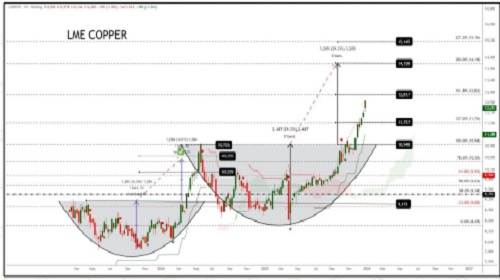
Copper has entered a decisive structural bull phase, supported by tightening fundamentals and a powerful technical setup. During 2025, LME copper prices rallied more than 40%, reaching record highs near USD 13,000 per tonne, driven by acute supply disruptions, tariff-led trade distortions, and resilient demand from electrification-linked sectors. On higher time-frame charts, copper has completed a rounding bottom, a classic long-term accumulation pattern that typically precedes sustained multi-year advances.
Supply: Constraints Are Structural, Not Cyclical
The supply side remains the key pillar of copper’s bullish outlook. Global mine supply growth for 2026 is expected to be modest, with estimates near 1–1.5%, insufficient to meet rising demand. Major disruptions at Indonesia’s Grasberg mine, Chilean operations, and African assets have tightened the concentrate market. With limited greenfield projects, declining ore grades, permitting challenges, and ESG constraints, copper supply lacks elasticity. As highlighted by leading global investment banks such as JPMorgan Chase, the refined copper market is projected to remain in deficit through 2026, reinforcing a structurally tight environment.
Trade flow distortions have further amplified tightness outside the US. Front-loaded imports into the US ahead of potential tariffs have effectively “locked” material domestically, keeping ex-US inventories lean. This leaves global markets vulnerable to even small additional supply shocks.
Demand: Energy Transition Is a Long-Duration Theme
Copper demand is increasingly driven by long-implementation themes rather than short-term cycles. Power grid upgrades, renewable energy installations, EV penetration, and AI-linked data centres are materially copper-intensive. Data center demand alone is expected to rise sharply in 2026, with incremental consumption adding meaningful pressure to already tight balances. Unlike past cycles, substitution away from copper remains limited in the near term, despite rising price differentials with aluminum.
China’s role has also evolved. While property-related demand remains subdued, non-property consumption—grids, renewables, EVs, and advanced manufacturing—has stayed resilient. Smelters face raw material tightness, increasing the risk of refined output constraints rather than exports acting as a pressure valve
Technical View and Price Outlook
Conclusion
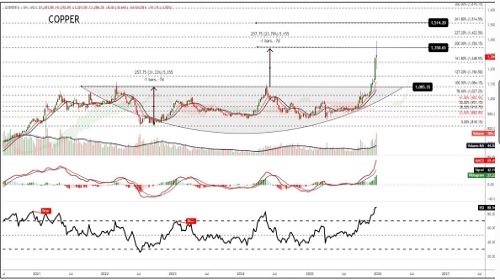
From a technical perspective, the long-term rounding bottom formation confirms a regime shift from consolidation to expansion. The sharp December rally may invite short-term pullbacks or a time correction, especially after such a strong momentum phase. However, these dips should be viewed as structural buying opportunities rather than trend reversals.
For 2026, copper is expected to trade with higher volatility but maintain a bullish bias. Immediate upside potential remains toward USD 14,150 per tonne (1520 on MCX), aligned with measured-move projections from the rounding bottom breakout. Pullbacks are likely to be corrective and shallow, supported by strong demand visibility and constrained supply.
Strategy Takeaway
Copper’s long-term outlook remains firmly bullish. Traders are advised not to chase momentum after sharp rallies, but to use corrective phases to build strategic long positions. With structural deficits, energy-transition demand, and a powerful technical base in place, copper is well positioned to remain one of the strongest industrial metals through 2026.
Above views are of the author and not of the website kindly read disclaimer