Bioenergy Installed Capacity Projected to Reach 15.5 GW by FY32 by CareEdge Ratings
Synopsis
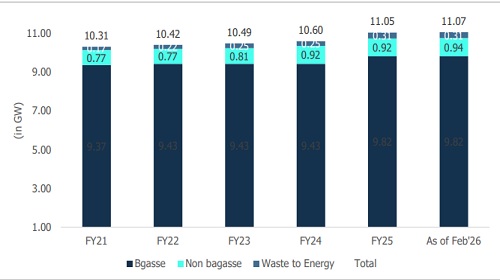
Bioenergy contributes 11.6?GW to India’s renewable energy mix as of March?2025, dominated by bagasse cogeneration, supported by biomass and waste?to?energy segments. This capacity has steadily expanded over the last five years, with the addition of around 868 MW of BM Power/Cogeneration and 693 MW of WtE nationwide, signalling sustained government support.
National initiatives such as the National Bioenergy Programme, the Waste?to?Energy Programme Guidelines, the Biomass Co?firing Policy, and the Biofuel Blending Targets are accelerating biomass cogeneration and pelletisation. These schemes provide targeted financial support, technology standards and stable offtake mechanisms that are strengthening project viability and driving steady growth in solid biomass?based bioenergy across the country.
Key growth drivers include abundant agricultural residue, rising demand for clean fuels, rural economic benefits, decentralised power generation and environmental gains such as reduced stubble burning and improved waste management. India’s large surplus of agricultural biomass estimated at 230?MMT annually, further strengthens the country’s long?term bioenergy potential.
Major challenges remain in biomass supply chains, seasonality, logistics, storage constraints and high aggregation costs, along with the difficulty of matching falling tariffs of solar and wind. There is a need for organised supply networks, digital logistics platforms and multi?supplier contracting to address these persistent operational bottlenecks.
Policy enablers such as financial assistance, support for biomass aggregation machinery, and improved RPO/RCO frameworks aim to reduce risks, strengthen bankability, and boost investor confidence. New policies also encourage long?term biomass procurement and renewable consumption mandates, creating stable demand signals for developers.
Going forward, India’s bioenergy potential, particularly in biomass?based power, pelletisation, cogeneration and waste?to?energy, is expected to expand steadily, supported by stronger supply chains and continued policy backing for biomass utilisation and co?firing in thermal power plants, which are projected to further accelerate India’s bioenergy expansion through 2030.
Overview
Bioenergy is a renewable form of energy obtained from recently living organic materials, collectively known as biomass. This biomass, such as agricultural residues, forestry waste and organic municipal waste, stores carbon that plants absorb from the atmosphere through photosynthesis. When used for energy production, the carbon is released during combustion but is subsequently reabsorbed by new biomass growth, creating a balanced carbon cycle. This makes modern bioenergy a near-zero emissions energy source. Bioenergy can be utilised to generate electricity, produce heat, create transportation fuels and develop various bio-based products, contributing to both energy security and environmental sustainability.
Feedstock
Feedstock refers to organic, biodegradable materials that are converted into usable forms of energy, such as electricity, heat, or biogas. These feedstocks originate from various sources, including agriculture, forestry and specially cultivated energy crops. In renewable energy systems, biomass feedstock such as algae, plant materials, and animal waste is commonly used to generate biofuels and energy. The type and quality of feedstock used directly impact the efficiency, environmental benefits, and economic feasibility of the WtE (Waste-to-Energy) process.
Agricultural residue is one of the most widely available sources of feedstock, especially in rural and farming regions. This residue includes materials such as paddy straw, wheat straw, corn stover, sugarcane bagasse, cotton stalks and animal manure, which remain after harvesting or as a by-product of farming. They can be processed through combustion, gasification, or anaerobic digestion to produce energy. Utilising these materials not only provides a renewable energy source but also reduces the harmful practice of open field burning.
Biomass Availability in India
As per Ministry of New and Renewable Energy (MNRE), in FY24, almost 750 million tonnes of agricultural waste was produced in India. Wheat waste contributes almost 25% followed by rice waste 24% and rest is contributed by other crop wastes. Since wheat straw is also used as animal fodder, rice straw and husk can be used in WtE generation. The surplus biomass availability is estimated at around 250 million tonnes in FY24, which can generate energy of 28 GW.
The biomass availability is estimated to increase by almost 27% to reach 948 million tonnes in FY25 whereas the surplus biomass availability is estimated to increase by 18% to reach 295 million tonnes. The bioenergy generation is estimated to increase from 28MW to 35 MW in FY25.
The ‘Others’ category, with a total of 184.7 MT, comprises biomass from banana, barley, coriander, cowpea (lobia), dry chillies, garlic, ginger, gram, guar seed, jowar, jute, linseed, masoor, mesta, moong (green gram), moth, onion, other kharif pulses, other oil seeds, peas & beans (pulses), potato, ragi, sesamum, small millets, sunflower, sweet potato, tobacco, turmeric and urad. Strengthening the supply chain for these residues could enhance bioenergy output and improve waste management efficiency, contributing to a diversified and resilient bioenergy sector.
Conclusion
India produces more than 700 million tonnes of agricultural residue annually, with estimates indicating that a substantial share remains under-utilised or is disposed of through open-field burning, particularly in northern Indian states. This practice contributes significantly to air pollution, greenhouse gas emissions, and declining soil quality, while simultaneously representing a lost economic opportunity.
“Reframing agricultural residue from ‘waste’ to a strategic national bioenergy resource can unlock significant socioeconomic and environmental gains, especially considering that India generates over 230 million tonnes of such residues annually, much of which remains under?utilised” says Tanvi Shah, Senior Director at Care Analytics and Advisory Private Limited.
“Realising Waste to Energy potential requires a coordinated and systems-based policy approach integrating agricultural supply chains, energy markets, environmental regulation, and financial incentives. With India projected to generate ~300 million tonnes of agricultural residue annually, a data?driven biomass mapping framework and strong institutional alignment will be critical to unlocking this opportunity” says Nitu Singh, Associate Director at Care Analytics and Advisory Private Limited.
Overall, Waste-to-Energy technologies offer multiple benefits - effective waste management, renewable energy generation, environmental protection and employment generation, making them an essential component of India’s pathway towards a sustainable and low-carbon future.
Above views are of the author and not of the website kindly read disclaimer