Below-Normal Rainfall Could Push Inflation Higher in FY27: smallcase manager
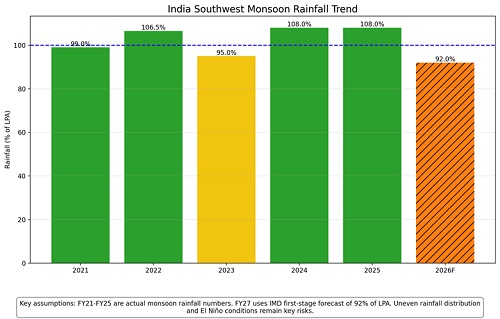
According to the latest report on pre monsoon outlook by CA Tapan Doshi, smallcase manager and Founder Thoughtful Investors Research LLP on, India’s FY27 macroeconomic outlook is expected to be heavily influenced by the upcoming monsoon season, with rainfall trends likely to play a critical role in shaping inflation, GDP growth, RBI policy decisions and overall market sentiment. With the India Meteorological Department (IMD) forecasting monsoon rainfall at 92% of the Long Period Average (LPA) — categorized as below normal — concerns are rising around food inflation, rural demand recovery and the trajectory of interest rates in the coming quarters.
The forecast also comes amid rising temperature concerns across the country. According to global air quality platform IQAir, on April 27, 2026, all of the world’s 50 hottest cities were located in India, highlighting the increasing intensity of heat conditions and the importance of a stable monsoon season for agricultural and economic stability.
The report highlights that while India’s economy continues to remain resilient amid global uncertainties, the monsoon still remains one of the most significant drivers of domestic economic stability. Nearly 55% of India’s net sown agricultural land remains rain-fed, making rainfall patterns crucial for crop output, food supply chains and rural income generation.
Agriculture contributes nearly 15-16% to India’s GDP while supporting the livelihoods of close to 45% of the country’s population. As a result, monsoon performance has a direct bearing on consumption trends, inflationary pressures, liquidity conditions and corporate earnings across sectors.
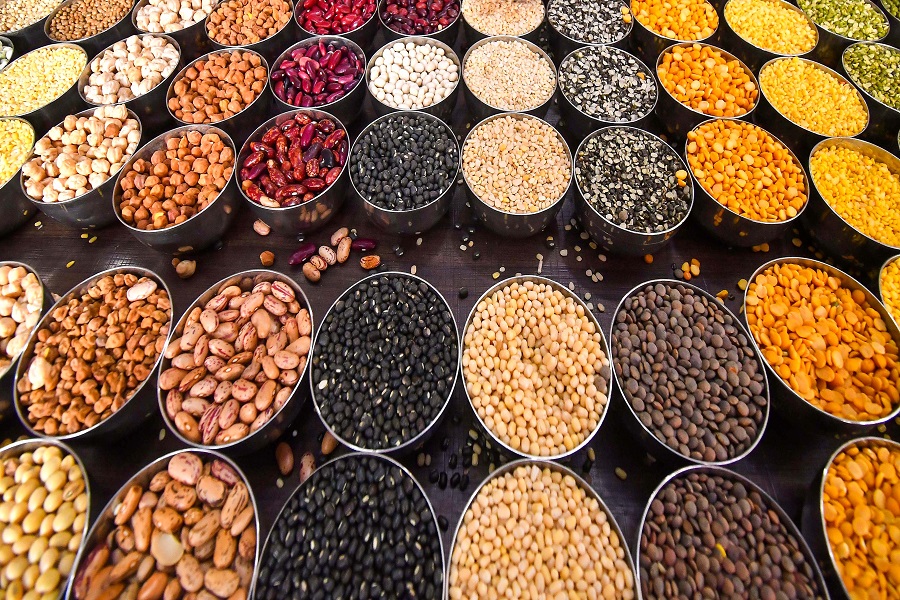
While aggregate rainfall levels remain important, the distribution and timing of rainfall across key agricultural states may prove even more critical during FY27. Regions dependent on monsoon-driven cultivation for crops such as rice, pulses, sugarcane, soybean and oilseeds remain vulnerable to delayed or uneven rainfall patterns. Any prolonged dry spells during sowing periods could negatively impact agricultural productivity and food availability.
At the same time, erratic weather conditions linked to climate change are increasing the frequency of rainfall imbalances, making the quality and spread of rainfall equally important as overall precipitation levels.
Food inflation has already started witnessing upward pressure in recent months, particularly across vegetables and essential commodities. Since food items account for nearly 46% of India’s Consumer Price Index (CPI) basket, any weather-led supply disruption could quickly translate into broader inflationary pressures.
Historically, weak or uneven monsoons have resulted in sharp increases in prices of vegetables, cereals, pulses and edible oils, while also affecting household consumption spending and rural purchasing power. The report warns that if rainfall remains below expectations during the peak monsoon months, headline inflation could accelerate meaningfully in the second half of FY27.
Such a scenario could complicate the Reserve Bank of India’s inflation management strategy at a time when markets are anticipating gradual monetary easing. The report suggests that rising food inflation could delay the RBI’s ability to adopt a more accommodative stance on interest rates and may keep liquidity conditions tighter for longer.
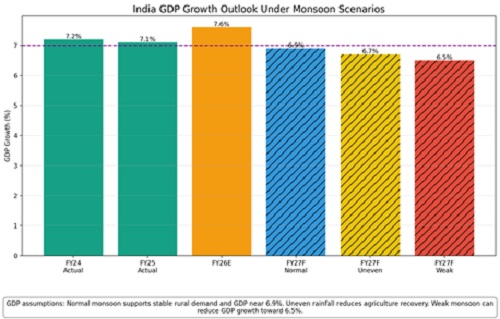
India’s GDP growth is currently expected to remain around 6.8%–6.9% under a stable monsoon scenario. However, the report estimates that prolonged rainfall weakness could potentially pull growth closer to 6.5%, primarily due to softer rural demand and weaker agricultural output.
The report also highlights that the pace of rural recovery in FY27 will largely depend on monsoon stability. A favourable monsoon generally improves farm incomes, boosts rural employment and supports demand across sectors such as FMCG, tractors, two-wheelers, fertilisers, affordable housing and microfinance.
Financial markets are also expected to remain highly sensitive to rainfall developments between June and September. Historically, monsoon trends have significantly influenced inflation-sensitive sectors, rural consumption stocks, bond yields and RBI policy expectations.
While rural-facing sectors may remain vulnerable to rainfall shocks, the report notes that government-led themes such as infrastructure, defence, railways and capital goods are expected to remain relatively resilient due to continued public expenditure and urban demand momentum
Outlook for FY27
The progress of the monsoon season will remain a closely watched factor for the Indian economy during FY27. Stable rainfall conditions could support inflation management and sustain growth momentum, while weaker rainfall patterns may increase inflationary pressures and create volatility across rural-linked sectors. The evolution of monsoon conditions over the coming months is therefore expected to play an important role in shaping inflation trends, GDP growth expectations and overall market sentiment during FXY27.
Above views are of the author and not of the website kindly read disclaimer