Base Metals Weekly Market Report: Sharp global correction amid macro risks, while physical market tightness persists by Emkay Global Financial Services

Market Commentary and Macro Trends
* Aluminum: Sharp global correction amid macro risks, while physical market tightness persists
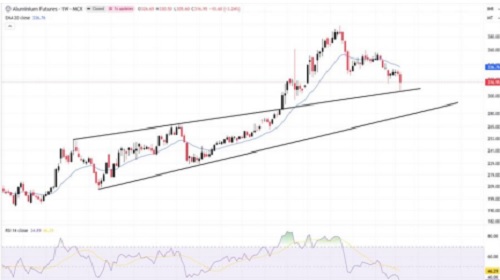
Aluminium prices witnessed a sharp correction last week amid a broad-based sell-off across industrial metals and weakness in global equity markets. LME three-month aluminium declined by more than 6% wow to close around $2,847/MT, while MCX aluminium corrected by approximately 3% to settle near Rs317/kg. SHFE aluminium futures closed around CNY22,200/MT. The relatively smaller decline in MCX was largely supported by the Indian rupee, which appreciated by more than 1.6% against the dollar to below Rs92.70, cushioning the impact of international price weakness.
Despite the correction in forward prices, nearby physical tightness remains evident. LME cash aluminium closed at $3,182/MT against the three-month forward price of $2,847/MT, keeping the cash-to-three-month backwardation elevated at $334.5/MT compared with $311.1/MT previously. On MCX, the first-to-second-month backwardation increased sharply to Rs4.60/kg from Rs3.65/kg, while SHFE's corresponding spread widened to CNY615/MT from CNY495/MT. The widening spreads suggest that immediate metal availability remains constrained despite the weakness in 3M forward prices.
China continues to provide an important fundamental cushion. SHFE inventories declined by approximately 9,450 tonnes to 119,223 tonnes. October primary aluminium imports declined 27% yoy to approximately 181,000 tonnes, while cumulative imports during January–October fell 9% to 2.011mn tonnes. Higher nearby premiums have reduced the attractiveness of imported metal, potentially moderating incoming shipments
Combined LME, SHFE, MCX, and CME warehouse stocks declined to approximately 344,130 tonnes. LME inventories fell to 223,525 tonnes, while SHFE stocks declined to 119,223 tonnes. The continued drawdown in exchange stocks and elevated backwardation provide support to the nearby physical market, although expectations of additional global production capacity remain a concern for forward prices.
The macro backdrop remains challenging, with escalating macroeconomic risks from persistent US inflation, expectations of restrictive Federal Reserve policy, and a stronger dollar. The Dollar Index is trading around 104, while weakness in global equities has triggered broad-based liquidation across industrial metals. These factors could keep selling pressure elevated, particularly if upcoming US economic releases reinforce expectations of tighter monetary policy. The rupee's appreciation, however, has provided a cushion to MCX prices
Markets will monitor US Manufacturing and Services PMIs, followed by Wednesday's Core PCE inflation, 3Q GDP, Durable Goods Orders, and Initial Jobless Claims. Core PCE is forecast at 3.2% yoy against 3.1% previously. Thanksgiving and the early US market close may result in thinner trading liquidity.
Market perspective: LME aluminium is expected to trade within $2,750–2,955/MT, while MCX aluminium may remain within Rs305–326/kg. The near-term bias remains cautious, although low inventories and elevated nearby backwardation could limit further downside. LME price movements and USD/INR will remain the key drivers for MCX.
Aluminum Technical Outlook
* Copper: Global supply shifts and risk-off sentiment weigh on MCX
Copper is facing increased volatility amid contrasting physical market conditions and weakening macroeconomic sentiment. While Shanghai continues to experience tight nearby availability, substantial copper stocks held in the US could gradually move toward Asia, potentially easing regional supply tightness. At the same time, a stronger US dollar, elevated Treasury yields, and broader risk aversion are adding pressure to global metal prices.
Global developments and impact on MCX
The potential movement of an estimated 30,000–80,000MT of US-held copper toward Asia before January could influence Chinese import premiums and SHFE nearby spreads. However, the timing and commercial viability of these shipments will depend on freight costs, Chinese premiums, and US tariff policy. Any increase in arrivals could ease Shanghai's nearby tightness and weigh on regional premiums. For MCX, developments in China remain important because changes in import premiums and physical availability can influence global copper sentiment. Although current tightness in Shanghai may offer some underlying support, the possibility of additional US-origin supply creates uncertainty over the near-term price outlook. Meanwhile, macroeconomic conditions remain unfavorable. A stronger dollar, rising US Treasury yields, and selling pressure across global financial markets have encouraged investors to reduce exposure to risk assets, adding to downside pressure on copper.
MCX technical outlook
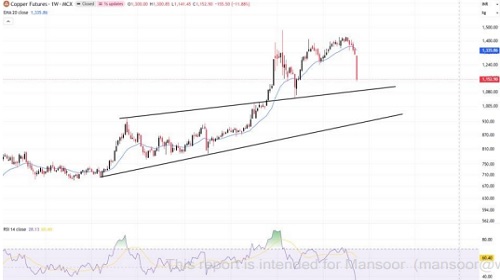
MCX copper witnessed a sharp weekly correction of 11.88%, closing at Rs1,152.90/kg and decisively breaking below its 20-week EMA of Rs1,335.86/kg. The breakdown indicates a deterioration in the technical structure, with volatility likely to remain elevated. Prices are expected to trade within the Rs1,100–1,190/kg range, with sharp swings possible in either direction. A sustained recovery will depend on stabilization in global sentiment and improvement in physical market conditions.
Market perspective:The near-term outlook for MCX copper remains cautious, with global risk aversion and uncertainty surrounding US–China metal flows likely to keep prices volatile. While tight nearby availability in China may provide intermittent support, potential supply arrivals and continued macroeconomic pressure could restrict recovery. The market is likely to remain sensitive to changes in Chinese premiums, inventory movements, and US trade policy.
Copper Technical Outlook
* Lead: Weak global sentiment keeps MCX prices under pressure
Lead remained under pressure amid broad weakness across base metals and cautious demand conditions in China. While falling LME inventories and tight concentrate availability provided some support to the global supply outlook, rising MCX stocks and a stronger rupee limited the scope for a domestic price recovery. MCX lead near month declined approximately 1.08% wow to Rs192.30/kg, while the next month contract fell 1.05% to Rs193.40/kg. Despite the decline, lead showed relative resilience against the broader base-metals complex, with copper falling 9.25%, aluminium 6.15%, and zinc 5.55% during the week. The relatively smaller decline reflects some underlying support from global lead availability. However, this has not translated into stronger domestic prices, as downstream buying remains cautious.
China and LME: Global signals for the domestic market
LME lead 3M declined 2.75% wow to $1,841.50/MT, while inventories fell by 21,825MT to 261,525MT. Although the continued stock drawdown signals tightening exchange availability, the Cash–3M contango widened from $29.90/MT to $36.80/MT, indicating weaker nearby market conditions. This suggests that inventory withdrawals have not yet translated into stronger immediate price momentum.
In China, demand conditions remain subdued, with cautious battery-sector procurement and weak downstream consumption limiting the scope for a sustained recovery. Although SHFE inventories edged lower by 194MT to 9,270MT, the broader demand environment remains a constraint. Earlier strength in Chinese refined lead imports also points to additional overseas supply entering the market, although narrowing import arbitrage may moderate these flows.
For MCX, these developments present a mixed picture, lower LME inventories, and tight concentrate availability offer underlying support, but weak Chinese demand and softer nearby pricing continue to weigh on global sentiment.
MCX lead inventories increased by 159.10MT during the week, rising from 408.79MT to 567.89MT as of 20-Nov. The increase in domestic exchange stocks, contrasting with the drawdown at LME and SHFE, suggests that local inventory conditions are less supportive and may limit near-term price gains.
Meanwhile, USD/INR declined from 94.20 to 92.70, reflecting rupee appreciation. A stronger rupee reduces the landed cost of imported lead and may cap domestic price gains, particularly while global prices remain weak. Hawkish Fed expectations and a stronger US dollar also continue to weigh on broader commodity sentiment.
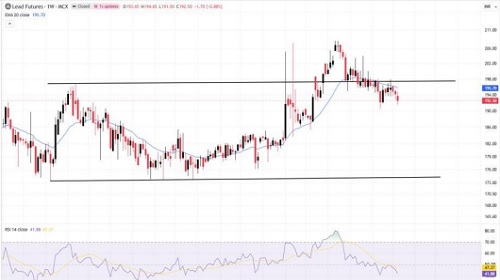
Market perspective: MCX lead continues to face downside risks, with Rs190/kg emerging as the immediate support level. A sustained break below this zone could accelerate selling pressure toward Rs181/kg. On the upside, Rs194–198/kg remains the key resistance band. A recovery above this range would be required to indicate an improvement in the near-term technical structure.
The near-term outlook for MCX lead remains cautious, with prices expected to trade in the Rs190–194/kg range and a sideways-to-bearish bias. While LME inventory drawdowns and tight concentrate availability may limit further losses, weak Chinese downstream demand, rising domestic stocks, and rupee appreciation continue to restrict recovery potential. A sustained break below Rs190/kg could expose the next support near Rs181/kg, while Rs194–198/kg remains the immediate resistance zone.
Lead Technical Outlook
* Nickel: Sharp correction amid macro headwinds and weak physical demand despite Indonesian supply concerns
Nickel prices witnessed a sharp correction last week, tracking weakness across industrial metals amid heightened macroeconomic concerns and subdued physical demand. LME three-month nickel declined approximately 3.33% wow to close at $15,375/MT, while MCX December futures fell around 5.84% wow to Rs1,435/kg. SHFE nickel also declined approximately 3.51% wow to CNY116,780/MT, reflecting broad-based selling pressure amid weak market sentiment and persistent inventory overhang.
LME nickel inventories increased by 2,460 tonnes wow to 275,184 tonnes, while SHFE inventories declined by 1,114 tonnes to 105,242 tonnes. MCX inventories also recorded a marginal increase from 40 tonnes to 47 tonnes. The divergence in exchange inventory movements has done little to alter the broader supply picture, with elevated LME stocks continuing to reflect ample market availability. On the spreads front, the LME cash-to-threemonth contango narrowed from $199/MT to $180/MT, while the MCX December–January contango widened from Rs22.80/kg to Rs24.10/kg. The persistence of contango across both markets, alongside elevated inventory levels, points to a comfortable near-term supply environment
Supply dynamics remain closely tied to developments in Indonesia, where the proposed policy requiring at least 70% of mining permit benefits to accrue to the state, along with expectations of tighter mining quotas, has added uncertainty to future production. Lygend's expected 50% production cut from 1-Dec could tighten intermediate nickel availability, although the impact on overall supply remains to be seen. Meanwhile, continued NPI availability and expanding HPAL capacity provide flexibility on the supply side. Demand fundamentals continue to remain weak, with limited buying activity across China's stainless steel and battery sectors. Stainless steel mills have largely completed their November–December raw material procurement, resulting in slower fresh buying and limited spot transactions. Battery-related demand also remains subdued, with nickel sulphate producers holding elevated inventories and precursor manufacturers showing limited willingness to build fresh stocks. These conditions continue to restrict the pace of demand recovery.
The macroeconomic backdrop remains challenging, with hawkish Federal Reserve signals, elevated US Treasury yields near 4.92%, and a stronger dollar weighing on industrial metals. The Dollar Index closed at 103.866, up 0.44% wow, while weakness in global equities amid concerns over technology and AI-sector valuations further dampened risk appetite. Market attention will focus on Wednesday's US Core PCE inflation, 3Q GDP, Durable Goods Orders, and Initial Jobless Claims, which could influence expectations surrounding the Federal Reserve's December policy decision. Movements in the dollar and Treasury yields will remain key drivers. Thanksgiving on 26-Nov and the early US market closure on 27- Nov may also result in thinner trading liquidity.
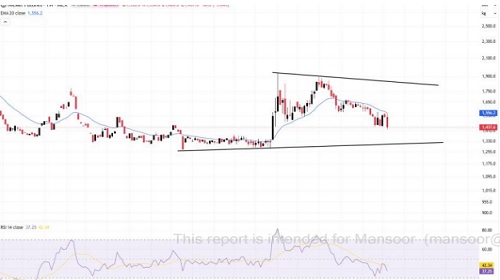
Market perspective: LME three-month nickel is expected to remain range-bound within $15,000–15,750/MT, while MCX December is likely to trade within Rs1,350–1,510/kg with a negative bias. Weak Chinese stainless steel demand, subdued battery-sector consumption, and elevated exchange inventories are likely to limit recovery attempts. However, expectations of tighter Indonesian mining quotas and Lygend's planned production cut from December could provide some downside support. Upcoming US economic data, global risk sentiment, and developments in Indonesian supply policy will remain key factors influencing market direction.
Nickel Technical Outlook
* Zinc: Macro headwinds and rising refined supply weigh on prices amid tight physical availability
Zinc prices remained under pressure last week, tracking weakness across industrial metals amid heightened macroeconomic risks and a broad-based sell-off in global equities. LME three-month zinc declined 5.5% wow to close at $3,504/MT, while LME cash zinc settled at $3,632/MT. SHFE zinc futures closed at CNY24,020/MT, while MCX zinc futures settled at Rs387.85/kg, declining nearly 4% wow.
The LME cash-to-three-month backwardation remained elevated at approximately $139/MT, indicating continued tightness in nearby metal availability despite weakness in forward prices. On MCX, the near-to-next-month backwardation stood at a significant Rs17.25/kg, highlighting substantial tightness in the domestic nearby contract structure. The steep backwardation suggests that immediate supply conditions remain firm despite the correction in outright prices. However, MCX zinc is trading approximately $350/MT above import parity, making domestic prices relatively expensive compared with international replacement costs. This premium could restrict fresh buying interest and limit domestic price recovery.
China remains central to the supply outlook. Persistent concentrate shortages continue to pressure smelter economics, with imported zinc concentrate treatment charges falling to deeply negative levels. Seasonal mine shutdowns in northern China and winter stockpiling requirements are adding to raw material procurement challenges. However, the resumption of operations at several Chinese smelters is expected to increase refined zinc production during November, potentially offsetting some of the supply constraints at the concentrate level. This divergence between raw material shortages and recovering refined output remains an important factor for the market.
Combined LME, SHFE, and MCX exchange inventories declined by approximately 9,415 tonnes to 257,268 tonnes. LME stocks fell to 145,675 tonnes, while SHFE inventories declined sharply to 112,776 tonnes. The continued drawdown in exchange stocks provides a fundamental cushion against aggressive downside movements, although higher refined production could moderate this support.
The macro backdrop remains challenging, with persistent US inflation, expectations of restrictive Federal Reserve policy, and a stronger dollar weighing on industrial metals. The Dollar Index is trading around 104, while weakness in global equities has triggered broadbased liquidation across commodity markets. The rupee's appreciation has provided some cushion to domestic prices.
Markets will monitor US Manufacturing and Services PMIs, followed by Wednesday's Core PCE inflation, 3Q GDP, Durable Goods Orders, and Initial Jobless Claims. Core PCE is forecast at 3.2% yoy against 3.1% previously. Thanksgiving and the early US market close could also result in thinner trading liquidity.
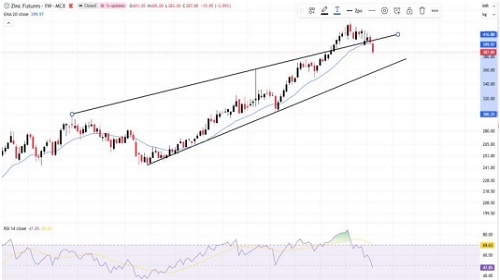
Market perspective: LME zinc is expected to trade within $3,400–3,650/MT, with a rangebound to bearish bias, while MCX zinc may trade within Rs365–400/kg. Dollar strength, recovering Chinese refined production, and subdued risk appetite could restrict upside attempts, while declining inventories, negative concentrate treatment charges, and elevated nearby backwardation may limit further downside
Zinc Technical Outlook
For More Emkay Global Financial Services Ltd Disclaimer http://www.emkayglobal.com/Uploads/disclaimer.pdf & SEBI Registration number is INH000000354