Telecom Sector Update :Digital, Data, Drift up in ARPU, Deleveraging by Elara Capital
The telecom industry’s evolution from basic voice services to full-scale digitalization is fueling a data consumption boom in India and globally. India is at the forefront of this shift, due to three structural changes: the most affordable tariffs, broad smartphone adoption, and extensive network expansion into the hinterland. Industry consolidation (from 17 operators to four), combined with sticky, high volume data use, sets the stage for a sustained rise in ARPU. We model in an ARPU CAGR of 7% during FY26-29E, which should reduce India’s tariff gap with global markets and restore attractive returns on invested capital. Higher ARPU, improving cashflow generation and moderating capex would drive balance sheet deleveraging. As the sector transitions from consolidation into a compounding phase, we expect free cashflow for operators to grow in the double digits.
Data consumption -- structural upswing:
Per-user monthly data consumption surged from ~15x to ~21GB during CY16–24 (Source: TRAI). The next phase will be deeper and more durable, driven by higher engagement intensity, new data-heavy applications (video, Cloud gaming, enterprise SaaS, & IoT) and broader digital integration across consumer and enterprise use cases. We see a credible path for per-subscriber use to exceed 65GB per subscriber in the next decade from ~21GB in CY24.
Telcos well placed to lift ARPU:
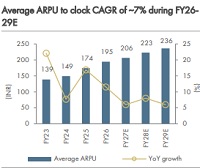
We expect ARPU CAGR to accelerate to 7% during FY26-29E, supported by:
1) Tariff hikes
2) Richer bundled service offerings
3) Elevated data use being a staple behavior
4) Disciplined pricing even if new market entrants arise. We expect blended ARPU to increase to 6% in FY27E, 8% in FY28E, and 6% in FY29E, driven by tariff resets and higher average consumption.
From consolidation to compounding:
With consolidation largely complete, India’s telecom industry is entering its strongest phase for cashflow generation and balance sheet repair. A quasi-duopoly market with some of the world’s lowest tariffs implies meaningful upside from tariff normalization, which should translate into stronger free cashflow generation, lower leverage, improving returns
Reliance Jio (Not Listed):
Reliance Jio is transitioning from a scale-led telecom operator to a monetization-driven digital platform. Backed by its integrated technology stack, Jio is building a scalable and structurally differentiated digital infrastructure ecosystem with strong long-term earnings visibility.
Sector in multi-year recovery; initiate with Buy on Bharti Airtel & Bharti Hexacom, and Accumulate on Indus Towers:
In our view, India’s telecom sector is in a multi-year recovery, driven by ARPU improvement, structural data demand, and lower incremental capex. This creates a favorable backdrop for earnings upgrade, deleveraging and higher free cashflow conversion. Key levers: tariff trajectory, execution of bundling and enterprise monetization, capex pace (5G densification) and regulatory developments. We initiate on BHARTI with a Buy rating for a TP of INR 2,387 based on 10x FY28E EV/EBITDA. We initiate on BHARTIHE with a Buy rating and a TP of INR 1,756 based on 14x FY28E EV/EBITDA. We initiate on INDUSTOW with an Accumulate rating and a TP of INR 491 based on 15x FY28E P/E. We believe RJIL’s enterprise value (EV) is ~INR 12-13tn based on 13x FY28E EV/EBITDA. JPL’s EV could be ~INR 13-14tn based on 13x FY28E EV/EBITDA (as considered in SOTP value of RELIANCE).
Please refer disclaimer at Report
SEBI Registration number is INH000000933











More News

Retail Sector Update : Sourcing/RM inflation key monitorable; prefer TTAN/VMM/PAG by Emkay G...