Stocks slip ahead of central bank decisions, key data

Asian stocks tumbled in early trading on Monday as investors reined in risk-taking at the start of a week sprinkled with key central bank decisions and data releases.
MSCI's broadest index of Asia-Pacific shares outside Japan shed 1%, led by a drop of as much as 2.7% in South Korean shares, one of the world's best-performing markets this year. "We roll into the final week of trading for 2025 before many square off their books and call it a year," said Chris Weston, head of research at Pepperstone Group in Melbourne. "Some will have already done so," he added.
"One suspects liquidity conditions will thin out this week from what is typical, but remain sufficient for size to be worked without excessively moving prices, but will then really drop next week."
S&P 500 e-mini futures were up 0.3%, while the yield on the U.S. 10-year Treasury bond was last down 1.2 basis points at 4.182% as investors awaited a string of economic data releases and a slew of decisions from central banks. Among the central banks making decisions this week, the Bank of Japan is expected to hike rates by 25 basis points to 0.75%, while the Bank of England may make an equal-sized cut to 3.75%. The European Central Bank is expected to keep interest rates on hold, alongside Sweden's Riksbank and Norway's Norges Bank. Investors will also have the chance to catch up on economic data that was delayed by the U.S. government shutdown, including the jobs report for November and the monthly consumer price index. Against the Chinese yuan trading offshore, the U.S. dollar was holding steady at 7.0532 yuan, hovering around its strongest level in more than a year, after factory output and retail sales data slowed further in November.
Official data showed on Monday that new home prices extended a decline in November, indicating that a recovery in demand remains elusive despite the government vowing to stabilise the sector.
China Vanke said it would convene a second bondholder meeting, after the state-backed property developer failed to secure bondholder approval to extend by one year a bond payment falling due Monday, increasing the risk of default and renewing concerns about the crisis-hit property sector.
"If Vanke ultimately defaults, we think the ramifications on the China property sector can be significant," said Jeff Zhang, equity analyst at Morningstar. "Investors may be more concerned about the balance sheet and government's attitude towards bailout for even the 'safe names'."
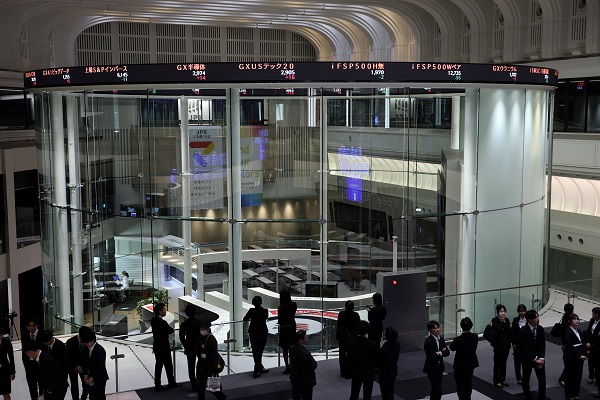
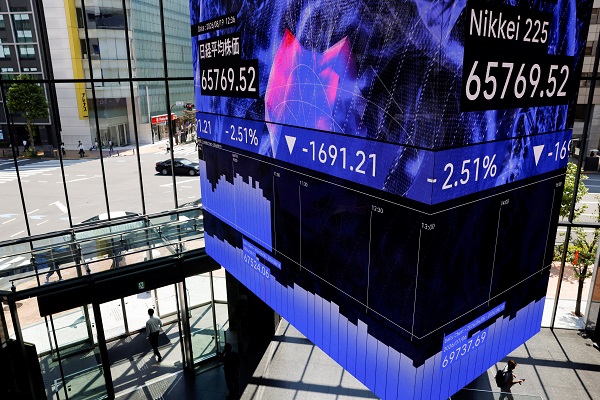
In Japan, stocks fell despite getting a lift after the BOJ's closely watched "tankan" survey showed on Monday that big manufacturers' business sentiment hit a four-year high, suggesting the economy was weathering the hit from higher U.S. tariffs. The Nikkei 225 was last 1.4% lower.
In commodities, Brent crude was 0.6% higher at $61.46 as supply fears from U.S.-Venezuela tensions and elsewhere lifted prices.
Imperial Oil said on Sunday it had issued a fire alert at its 120,000 barrel-per-day refinery facility in Ontario, Canada. Meanwhile, Russia said that an oil refinery in Afipsky was undamaged by a Ukrainian drone attack. On the geopolitical front, U.S. envoy Steve Witkoff said "a lot of progress was made" in peace talks to end the Ukraine war in Berlin on Sunday. Gold extended its recent rally into a fifth day as it approaches a record high of $4,381.21. Spot bullion prices were last up 0.5% at $4,325.51. Cryptocurrency markets snapped a three-day losing streak, with bitcoin last up 1.2% at $89,517.01 and ether rising 1.1% to $3,116.42.