Seoul shares up nearly 13 pc on tech boost
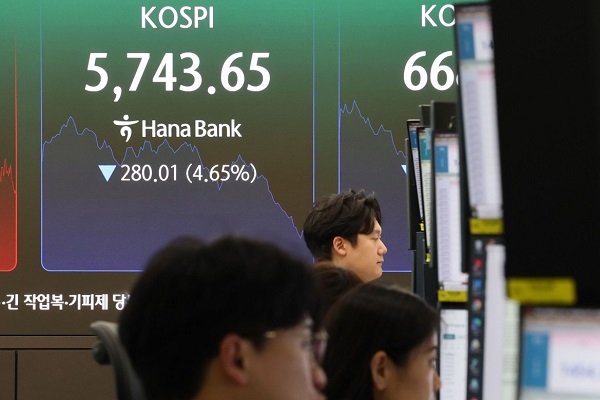
South Korean stocks traded nearly 13 per cent higher late Friday morning as investors scooped up semiconductor shares following Microsoft's strong earnings.
After opening 1.15 percent higher, the benchmark Korea Composite Stock Price Index (KOSPI) expanded its gains, adding 717.3 points, or 12.82 percent, to trade at 6,310.86 as of 11:20 a.m.
The surge followed a three-session heavy sell-off due mainly to concerns over artificial intelligence (AI) spending. The KOSPI fell nearly 40 percent this month alone, reports Yonhap news agency.
Overnight, Wall Street closed higher as Microsoft's stronger-than-expected earnings report eased fears about massive spending on AI infrastructure.
The S&P 500 climbed 1.66 percent and the Nasdaq gained 2.78 percent, while the Dow Jones Industrial Average rose 1.19 percent. The PHLX chip index, a gauge of U.S. semiconductor giants, surged 8.2 percent.
In Seoul, market bellwether Samsung Electronics shot up 18.24 percent, and SK hynix skyrocketed 21.86 percent.
Top carmaker Hyundai Motor jumped 6.98 percent, and internet firm Naver gained 5.03 percent.
Leading shipbuilder HD Hyundai Heavy Industries rose 4.13 percent, and defence giant Hanwha Aerospace advanced 4.86 percent.
The Korean won was trading at 1,432.4 won against the U.S. dollar as of 11:20 a.m., down 14.4 won from the close of stock trading the day before.
Meanwhile, South Korea's industrial output rebounded in June from a month earlier, snapping two months of decline led by the automobile and semiconductor industries, data showed on Friday, with retail sales and facility investment also gaining ground.
Industrial production added 2.3 percent last month from May, according to data from the Ministry of Data and Statistics. It marked the sharpest growth since a 2.9 percent rise posted in June 2020.
It was also the first time since March for the three economic indicators to rise simultaneously.
Output in the mining and manufacturing sector, a key pillar of the economy, shot up 6.4 percent on the back of the automobile and chip industries.








.jpg)

.jpg)