R&D-Focused Companies Deliver 23.5% Returns, Outpacing NSE 500: Monarch AIF

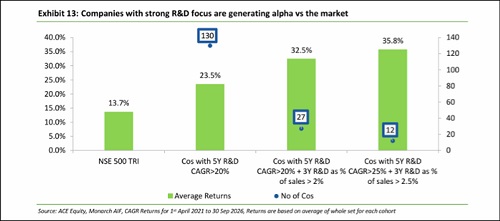
Companies that have consistently increased their Research & Development (R&D) spending have delivered stronger historical stock returns than the broader market, according to an analysis by Monarch AIF. The 130 companies that grew their R&D expenditure at a CAGR of over 20% during FY21–FY26 delivered an average stock-price CAGR of 23.5% between April 2021 and September 2026, nearly 10 percentage points ahead of the 13.7% generated by the NSE 500 TRI. The outperformance was sharper still where fast R&D growth was backed by meaningful R&D intensity: the 27 companies that also spent over 2% of sales on R&D on a three-year basis delivered an average CAGR of 32.5%, more than double the NSE 500 TRI and around 9 percentage points above the broader high-R&D-growth group.
“The findings challenge the perception that reducing R&D expenditure to protect near-term earnings necessarily benefits shareholders. While cutting research costs may improve reported profitability in the short term, sustained investment in innovation can help businesses develop differentiated products, strengthen competitiveness and build capabilities for future growth,” says Abhisar Jain, Head & Fund Manager – Monarch AIF.
Only 28 listed companies spend more than 5% of sales on R&D
According to Monarch AIF, only 28 of more than 2,000 listed companies spend over 5% of sales on R&D, while 59 companies spend more than 3%. The findings highlight the limited prevalence of high R&D intensity among India's listed companies, underscoring the scope for greater corporate investment in research and innovation.
India's R&D spending remains well below global peers and has remained stagnant since 20 years, unfortunately
The outperformance of companies investing in research comes against the backdrop of India's relatively low national R&D expenditure. The latest figures cited in Monarch AIF's report place India's Gross Expenditure on Research and Development (GERD) at Rs 2.45 lakh crore in FY24, equivalent to 0.84% of GDP. The private sector accounted for 52% of the total
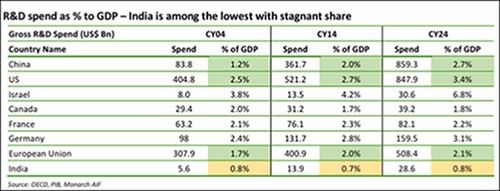
China has increased its R&D expenditure as a share of GDP from 1.2% in CY04 to 2.7% in CY24, while India's share has remained broadly stagnant over the same period. The gap highlights the challenge facing India as it seeks to strengthen domestic innovation and develop globally competitive businesses.
The picture is similar across India's listed corporate sector. According to Monarch AIF's analysis, average R&D expenditure as a proportion of sales declined from 0.64% in FY16 to 0.56% in FY26. Despite an increase in absolute spending, research continues to account for a relatively small share of revenue across much of the listed corporate universe.
The 2047 imperative: Making innovation a strategic priority
India's ambition to become a developed economy by 2047 will require more than scale, cost advantages and domestic consumption. Greater investment in research and the development of home-grown intellectual property can help Indian companies build differentiated products, improve pricing power and compete more effectively in global markets. “India urgently needs to emulate economies like the US, China and Europe and increase its R&D spend as % of GDP to ~2% if it aspires to realise its goal of a developed economy by 2047,” concludes Jain.
Above views are of the author and not of the website kindly read disclaimer