Quote on Fed Policy Reaction by Shriram Group Appoints Dr. Apoorva Javadekar as CEO, Shriram Research

Below the Quote on Fed Policy Reaction by Shriram Group Appoints Dr. Apoorva Javadekar as CEO, Shriram Research
* Decision: The FOMC unanimously raised the federal funds rate by 25 bps to 3.75%–4.00%, seeking a ”timelier” return of inflation to its 2% target after 65 consecutive months above target. The Committee characterized economic activity as expanding at a “solid pace,” suggesting that resilient growth gives the Fed greater room to focus on restoring price stability. Chair Kevin Warsh reinforced the hawkish message, noting that recent inflation data have yet to show sufficiently broad-based deceleration across product categories to justify holding rates steady. What Changed Since Last Meeting? Fed Chair Kevin Warsh highlighted three developments since the previous FOMC meeting: i) the escalation of the Iran crisis, which pushed oil prices back to around $105/bbl; ii) hotter-than-expected US inflation data, with both core (0.3% m/m) and supercore (0.5% m/m) inflation accelerating, pointing to a broadening of underlying price pressures; and iii) further strengthening of economic activity, reflected in resilient consumer spending, solid capex, and a stable unemployment rate.
* Projections: The FOMC dot plot—members’ projections for the future path of the policy rate—shifted substantially higher. Sixteen FOMC members now expect the federal funds rate to end 2026 above 4%, up from six at the June meeting, underscoring the Committee’s sharp hawkish shift in its rate outlook.
* US Asset Markets: 2Y and 10Y US yields surged by 13 bps and 5 bps, respectively, soon after the Fed chair’s speech. 2Y was trading at 4.71% and 10Y at 5.01% at the time of the writing. Critically, consistent with the narrative of a rate hike restoring the Fed’s inflation-fighting credibility, inflation expectations—proxied by 2Y and 10Y breakeven rates—fell by 4.2 and 3.3 basis points. The 2Y expected inflation now stands at 2.47%, down from 2.51%. The dollar index inched up 0.54%, while gold fell 1.8% to $4271/ounce, reacting to higher yields and the dollar. The market-implied chances of at least one rate hike by Dec-26 jumped from 67% to 71% from pre- to post-FOMC (Table 1)
* INR (NDF Market): The INR has come under pressure as the India–US rate differential has narrowed. Over the past six months, the 10Y spread has compressed by 44 bps to 207 bps, while the 2Y spread has narrowed by 37 bps to 196 bps. Both spreads now stand around 1.2σ below their respective five-year means. Amid last week’s bond sell-off, the INR weakened from 94.50 on 7 September to 95.95. The NDF market pointed to further INR weakness after the FOMC, with the 1M USDINR forward rising from 96.17 to 96.32. (Table 1)
Spillovers to India, and India’s Dilemma (Not Trilemma)
* Indian Yields Vulnerable: Indian bond yields are susceptible to US yield changes, with the 12M rolling correlation between US and Indian yields at 0.70% for both 2Y and 10Y yields. The 30-day rolling correlation is even higher at 88% for 2Y, rising from 60% in Jun-26, consistent with the pattern that US and EM/Asian bond yields become more correlated during a higher-yield regime. With Fed rates rising and the Fed entering a clear rate-hike cycle, Indian bond yields will be more vulnerable at both the short and long ends of the yield curve. Our in-house estimates suggest a 60% peak pass-through to 10Y Indian yields within 5 days following a 10 bps shock to the US 10Y yields.
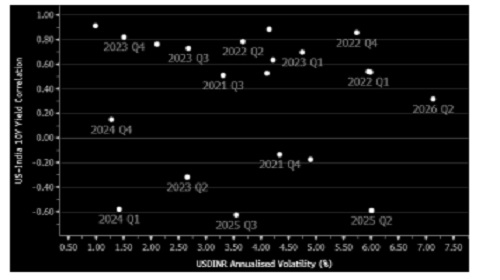
* India Faces a Dilemma, Not a Trilemma: Monetary Independence is at Risk: A classical Mundell-Fleming “Impossible Trilemma” asserts that with an open capital account, a central bank must choose between a fixed currency and control over domestic interest rates, but not both. In other words, a floating currency protects monetary independence. Recent empirical evidence across EM countries, by contrast, finds that central bankers have even less policy room; with an open capital account, a central bank loses control over domestic interest rates regardless of a fixed or floating exchange rate regime. “Global Financial Cycles/factor” prices EM bonds internationally, irrespective of currency regimes. Q4-2022 offers a powerful illustration: when the Fed raised rates by 125 bps at the end of 2022, Indian domestic rates surged, even as the central bank let the INR depreciate by 5%. In general, high FX volatility (a proxy for a floating FX regime) does not break a high correlation between the US and Indian yields. (Figure 1)
Should the RBI Respond to the Fed Rate Hike?
No! We do not think the RBI should or would respond to rising US yields or a narrowing differential. With FX Reserves at $785 billion, the RBI has ample ammunition to manage the INR (and at the same time drain liquidity from the banking system). We think rates are an inefficient tool for controlling currency. The Indonesian Rupiah continued to weaken despite a surprise rate hike at an unscheduled Bank of Indonesia meeting in May this year. Indian rates already sit among the highest in the emerging market universe, leaving the RBI with limited room to maneuver. A rate hike, if not warranted by domestic inflation dynamics, risks choking growth impulses and widening fiscal deficits, feeding back into renewed currency weakness, making a rate hike self-defeating (Figure 2).
Above views are of the author and not of the website kindly read disclaimer