PL Capital: Oil Above $100, Rising Bond Yields, Dollar Above 100 and Record Foreign Selling Test Indian Equities as Domestic Investors Step In

The Nifty 50 fell 6.06% in September, its worst September since 2018, as Brent crude crossed $100 and global bond yields surged; domestic institutional investors bought ?76,030 crore, absorbing 1.7 times the foreign selling
PL Asset Management, the asset management arm of PL Capital Group, has released its PMS Monthly Newsletter for September 2026, highlighting a sharp correction in Indian equities amid a challenging global environment. While rising bond yields, higher crude prices, central bank rate hikes, a weaker rupee and sustained foreign investor selling weighed on markets, domestic economic indicators remained supportive and domestic institutional investors continued to provide a counterweight to foreign outflows.
September saw several external pressures converge. Brent crude moved above $100 amid Gulf supply disruptions. The rupee weakened 0.68% to ?95.83 per dollar by month-end, after touching a record low of about ?96.35 during the month, as higher oil prices, a stronger US dollar and foreign outflows added pressure. The US 10-year Treasury yield rose to 5.29%, and the US Federal Reserve raised rates for the first time since 2023. The Bank of Japan also raised rates during the month, putting the yen carry trade back in focus. Against this backdrop, the Nifty 50 fell 6.06% to close at 22,615.25, marking its worst September since 2018, with seven consecutive weekly declines through 25 September.
Global equity markets reflected the challenging environment, with performance diverging across regions and indices. The sell-off in India was accompanied by pressure across market segments, although small caps held up comparatively better than mid caps. Despite the correction, domestic activity and earnings indicators continued to point to resilience in the Indian economy.
Domestic Investors Absorb Foreign Selling as Economic Indicators Remain Resilient
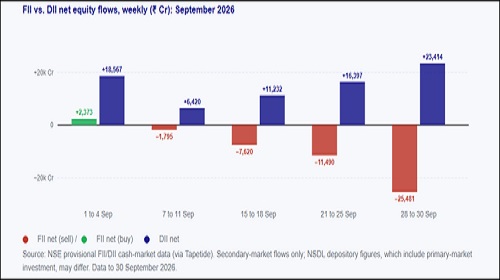
Foreign institutional investors (FIIs) reversed the buying seen in July and August, recording net equity selling of ?44,013 crore in September. Selling intensified towards the end of the month, with IT, financials and autos among the sectors facing pressure.
Domestic institutional investors (DIIs), however, remained consistent buyers. They purchased ?76,030 crore in equities and were net buyers in all 21 trading sessions during September, absorbing approximately 1.7 times the foreign selling. Systematic investment plan (SIP) flows also reached a record, reinforcing the role of domestic capital in supporting the market through a period of heightened volatility.
The correction came even as domestic economic indicators remained firm. Industrial output grew 8.0% in August, September's flash purchasing managers' indices (PMIs) pointed to renewed momentum, and forecasts for FY27 GDP growth were revised upwards by 50 to 100 basis points. Q1 FY27 earnings also beat expectations across market capitalisations, with Nifty profit after tax growth reaching a 10-quarter high. These indicators suggest that the market weakness was driven primarily by external pressures rather than a deterioration in domestic growth.
The Valuation Reset: Large Caps Move Towards Historical Averages
September's correction brought Indian equity valuations lower, although the adjustment remained uneven across market segments. The Nifty 50's 12-month blended forward price-to-earnings multiple stood at 17.4x, below its long-term mean of 19.6x and close to levels associated with the COVID-era market correction.
Mid-cap valuations also declined, with the Nifty Midcap 150 trading at 25.4x against its long-term mean of 27.4x. Small caps, however, remained above their historical average: the Nifty Smallcap 250 traded at 23.1x against a long-term mean of 20.9x. The Nifty 500 stood at 19.4x against its long-term mean of 20.9x.
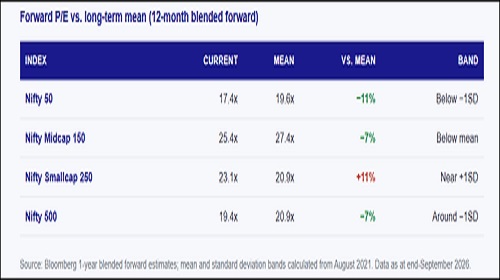
The valuation adjustment has therefore brought large-cap multiples below their long-term average, while small caps continue to trade above theirs. The next phase of market returns will depend on earnings delivery and the potential for valuation re-rating.
Quant Strategies Highlight the Importance of Defensive Positioning
The September correction highlighted the role of disciplined investment positioning in navigating volatile market conditions. PL Asset Management's AQUA strategy returned −2.45% during the month, outperforming its benchmark, the BSE 500 TRI, which declined 5.57%, and delivering an alpha of 3.12 percentage points. The strategy's performance was supported by a 17% cash allocation and minimal exposure to the IT sector, which fell 11.2% during the month.
LEAP, TRINITY and ELEVATE also outperformed their respective benchmarks modestly. ATOM lagged following a strong August as the sell-off extended into mid- and small-cap stocks, while MADP underperformed as gold and equities declined together, creating a challenging environment for an equity-gold allocation.
Siddharth Vora, Head – Quant Investment Strategies & Fund Manager, PL Asset Management Said,
“In the last edition we said the swing factors heading into September were oil, the currency, the Fed and the situation in Hormuz. September delivered on all four at once: Brent went back above $100, the rupee touched a record low of about 96.35 per dollar, the Fed raised rates for the first time since 2023 with the Bank of Japan hiking in the same week, and the situation in Hormuz worsened, with only about 10 commodity vessels transiting the strait on 23 September against a pre-war norm of around 125 a day. The Nifty fell 6.06%, its worst September since 2018. This was not a domestic growth scare. Industrial output grew 8.0% in August, September's flash PMIs pointed to renewed momentum, and FY27 GDP forecasts have been revised up by 50 to 100 bps. The foreign return we flagged last month did not last, with FIIs selling ?44,013 crores, but DIIs bought ?76,030 crores and were net buyers in every one of the month's 21 sessions.
Our strategies were positioned more defensively going into the month, and the results reflect it. AQUA returned −2.45% against −5.57% for its benchmark, an alpha of 3.12%, helped by a 17% cash allocation and minimal exposure to IT, which fell 11.2%. LEAP, TRINITY and ELEVATE each outperformed their benchmarks modestly. ATOM lagged after a record August as the sell-off reached into mid and small caps, and MADP underperformed as gold and equities fell together, the hardest environment for an equity-gold allocation.
September has also reset valuations. Two years ago the Nifty 50 traded at about 24.8x one-year forward earnings; today it is around 17x, below its 10-year mean of about 19.5x and within the 17x to 18x range that has historically marked time-correction bottoms, though still above the roughly 15x of the COVID low, so this is not a capitulation valuation. The reset has been uneven across the market. Mid caps have seen the sharpest correction in multiples, with forward P/E down by more than a third from September 2024, while small caps have eased only from about 25x to about 23x and still trade above their long-term average.
The core of the thesis is intact. With valuations now normalised, we see future returns coming from two fronts: earnings delivery and valuation re-rating. Either can support the market on its own, but when the two come together the move can be both sharper and faster. In our view, periods like this are when high-quality businesses become available at reasonable valuations, and we are positioned to benefit as earnings and multiples recover together.”
OUTLOOK
Earnings Delivery and Global Conditions to Shape the Next Phase
PL Asset Management's September assessment highlights a market facing a more challenging external environment even as India's domestic growth momentum remains intact. The correction has brought large-cap valuations closer to historical averages, while small caps continue to trade above their long-term mean. This makes earnings delivery a key variable for the market from here.
The upcoming Q2 FY27 results in October will provide insight into how higher crude prices and input costs affect corporate margins. Monetary policy decisions by the Reserve Bank of India, the US Federal Reserve and the Bank of Japan will also influence the direction of rates and currencies. Oil prices, the rupee and global bond yields remain the principal external variables to watch.
The newsletter's assessment is that domestic growth and institutional flows will continue to provide support, although with less room for error than a month ago. In this environment, the focus shifts towards large caps and earnings quality rather than chasing market segments that remain expensive. The longer-term investment thesis rests on the combination of earnings delivery and a potential valuation re-rating.
Above views are of the author and not of the website kindly read disclaimer