Paddy Report as on 06th April 2026 by Amit Gupta by Kedia Advisory
Conclusion - 05 March 2026
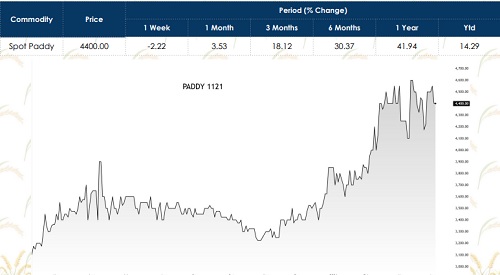
Price Performance - Paddy prices declined sharply, falling nearly 3.50% during the week as export shipments to West Asia were disrupted amid escalating geopolitical tensions. The suspension of Basmati exports to major buyers such as Iran, Saudi Arabia and the UAE has weakened demand sentiment. With domestic supply abundant and prices hovering close to MSP levels, market sentiment remains pressured in the near term.
Export Disruption - Exports of Indian Basmati rice to West Asia have been temporarily suspended due to the intensifying regional conflict. Nearly 70–75% of India’s annual 6 million tonnes Basmati exports are linked to these markets, making trade flows highly vulnerable. The potential disruption of the Strait of Hormuz could also delay payments and increase exporters’ working capital cycles by 60–90 days, weighing on domestic prices.
Strong Domestic Procurement & Stocks - India’s rice procurement for the Oct–Feb period reached 46.3 million tonnes, reflecting a 1.9% increase year-on-year despite a 17% decline in February purchases. Additionally, the Food Corporation of India holds around 7.8 million metric tons of milled rice stocks, ensuring strong domestic buffer availability. Elevated inventories combined with moderated procurement targets are adding supply pressure in the domestic market.
Record Production Outlook - The Ministry of Agriculture revised Kharif rice production to a record 124.5 million tonnes, marking a 1.4% YoY increase. Meanwhile, USDA forecasts India’s total rice output at 151–152 MMT for 2025-26, supported by a favorable monsoon and improved yields. While strong production ensures supply stability, the resulting surplus may create oversupply conditions in the domestic market by Q3 2026.
Technical Outlook - Technically, the market remains under pressure as momentum indicators reflect weak sentiment. RSI indicates declining momentum, while MACD signals a bearish bias, suggesting sellers maintain control. Volatility indicators imply further price swings as the market digests large supply and export uncertainty. Price action indicates a downward trajectory unless resistance levels are sustainably breached in the near term.

Performance
Highlights
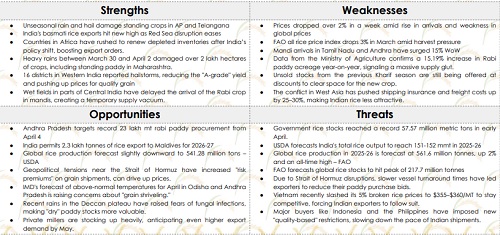
? Rice prices dropped over 2% weekly amid rising arrivals and weak global cues.
? FAO rice price index declined 3% in March due to harvest pressure.
? Mandi arrivals in Tamil Nadu and Andhra Pradesh surged 15% week-on-week.
? Rabi paddy acreage increased 15.19% year-on-year, signaling higher upcoming supply.
? Unsold Kharif stocks offered at discounts to clear space for new arrivals.
? Higher freight and insurance costs reduced competitiveness of Indian rice exports.
? Andhra Pradesh targets record 23 lakh tonnes rabi paddy procurement this season.
? India allowed 2.3 lakh tonnes rice export to Maldives for 2026-27.
? Global rice production forecast slightly lowered to 541.28 million tonnes by USDA.
? Geopolitical tensions near Hormuz increased risk premiums on global grain shipments.
? IMD warns above-normal temperatures may cause grain shriveling in key regions.
? Private millers aggressively stocking, expecting stronger export demand in coming months.
? Unseasonal rains and hailstorms damaged standing paddy crops across multiple states.
? Basmati exports surged as easing Red Sea disruptions improved shipment flows.
? African countries increased rice imports to replenish depleted inventories post policy changes.
? Government rice stocks reached record 57.57 million tonnes, increasing supply pressure.
? Vietnam lowered rice prices, intensifying competition for Indian rice exports globally.
SWOT Analysis