MSME funding shortfall estimated at Rs 55.18 Tn by 2030: B2K Analytics

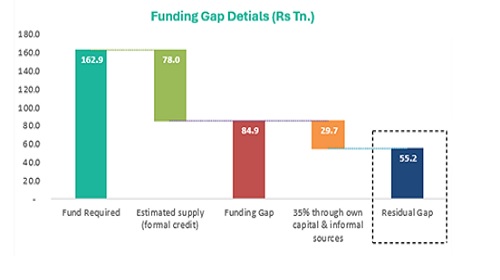
According to a recent report by B2K Analytics, the MSME sector’s total funding requirement is estimated to reach Rs 162.92 trillion by 2030. On the supply side, formal credit availability is projected at Rs 78.02 trillion. This includes Rs 56.98 trillion from priority sector lending, Rs 18.57 trillion from scheduled commercial banks (SCBs), and Rs 2.46 trillion from NBFCs.
An additional 5% of the funding gap is expected to be met through informal sources, while around 30% will be supported by promoters’ own capital infusion. Despite these sources, according to B2K Analytics, the unmet funding requirement for MSMEs is estimated at Rs 55.18 trillion by 2030.
“Our projections reflect strong long-term growth trends in terms of expansion in MSMEs contribution to GDP. Formal credit growth is also expected move in tandem. However, despite the growth momentum, there remains a substantial and widening credit gap in the MSME space, demanding an urgent need to expand formal financing channels,” says Ritaban Basu, CEO, B2K Analytics.
MSMEs’ growing contribution to the GDP
This persistent gap is noteworthy since the MSME sector’s contribution to India’s GDP is projected to increase from the current 30% to 40% by 2030. India’s GDP is expected to reach Rs 537.96 trillion, assuming sustained economic growth. This would place the MSME segment’s contribution at approximately Rs 215.18 trillion, underscoring its expanding role in the economy.
Access to financing has long been a challenge for Indian MSMEs. The projected funding gap highlights the urgent need to expand formal financing channels, deepen credit penetration, and develop innovative funding mechanisms to sustainably support MSME growth.
Improving access to formal credit
As per B2K Analytics’ estimates, ~95% of the MSMEs operate informally, making it difficult for lenders to assess their creditworthiness. As a result, formalisation should be a key priority. For instance, filing GST returns improves transparency around business activity and financial performance.
Adopting digital payment systems such as UPI and online banking helps create a verifiable transaction history, enabling lenders to better evaluate financial health. These systems also improve cash flow management, giving MSMEs greater control over their finances while maintaining clear financial records. This, in turn, enhances credibility and increases the likelihood of accessing priority sector lending and government schemes.
Another way to bridge the funding gap is through equity-based financing, such as SME IPOs on stock exchanges, which allow MSMEs to raise capital directly from the market. Greater formalisation will further facilitate access to both debt and equity financing over time.
Above views are of the author and not of the website kindly read disclaimer