India's merchandise exports may jump 17.6 pc to $131.2 billion in Q2
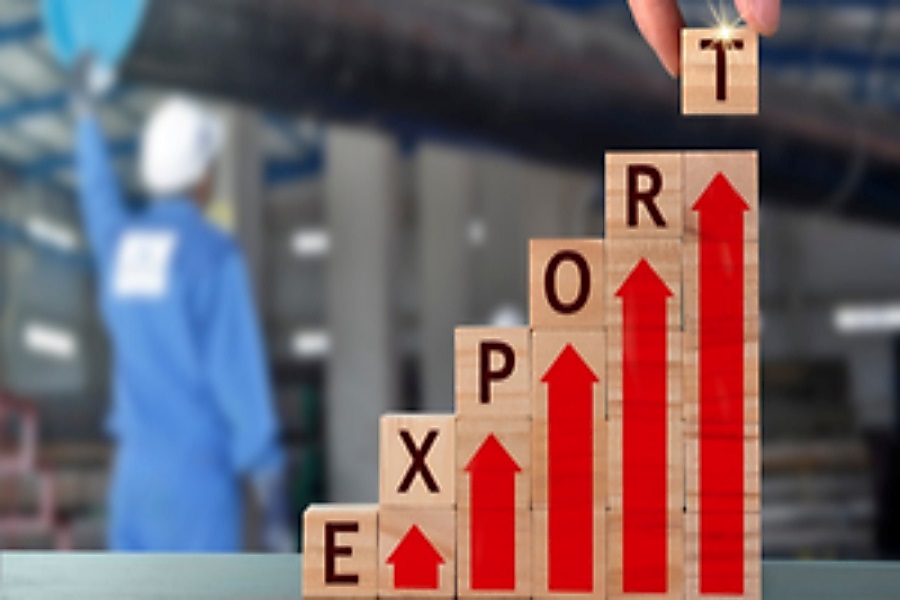
India's total merchandise exports for the July?September quarter of fiscal 2027 are projected at $131.2 billion, marking a year?on?year rise of 17.6 per cent, a report said on Wednesday.
The report from India Exim Bank forecasted non?oil exports at $113.8 billion, up 20.3 per cent during Q2 FY27.
Non?oil and non?gems and jewellery exports are projected at $105.8 billion, growing 20.5 per cent during the quarter.
Despite global uncertainties, the growth in exports stemmed from increasing geographical diversification along with favourable prospects arising from recent trade agreements with major trading partners, supported by buoyant demand in partner countries.
"India’s positive export outlook is expected to be driven by sustained expansion in domestic manufacturing and exchange rate movements. However, there are downside risks emanating from geopolitical conflicts and volatility in international commodity markets," India Exim Bank said.
The bank produces quarterly forecasts using an in?house Export Leading Index, or ELI, model that combines external and domestic factors to assess export momentum.
India’s merchandise exports during the April-June quarter (Q1) of FY 2026-27 recorded an all-time quarterly high of $129.6 billion, compared to $111.6 billion in the corresponding period of the previous year, registering a robust growth of 16.1 per cent, the Parliament was informed this week.
The data reflected the underlying strength of India’s export performance despite monthly fluctuations in the trade deficit.
The merchandise trade deficit of $30.4 billion in June 2026, which was reported as a five-month high, was only marginally higher than the 12-month average deficit of $29.3 billion.
The trade data also showed that the June 2026 deficit remained broadly in line with the average level, Minister of State for Commerce and Industry Jitin Prasada said in Lok Sabha, adding that the government closely monitors trade performance, including the merchandise trade deficit.





.jpg)