Franklin India Corporate Debt Fund July 2026

Current portfolio construction
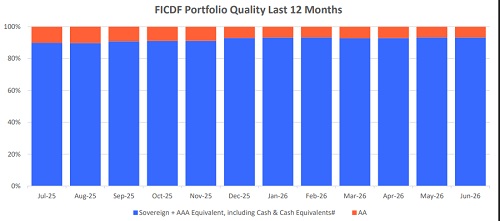
The current portfolio (as on 30th June 2026) construction involves exposure to high credit quality bonds. The portfolio is predominantly invested in AAA rated papers. The portfolio also comprises of around 12.7% exposure to sovereign rated State Government Securities (SGS)
Outlook
* The Reserve Bank of India in June policy meet maintained the repo rate at 5.25% and retained a neutral stance, balancing growth support with inflation vigilance. While inflation has inched higher and growth expectations have moderated, the RBI remains focused on supporting growth while retaining the flexibility to act if inflation trends closer to the upper end of its 4–6% target band.
* The fund continues to be positioned with a constructive bias, supported by evolving domestic liquidity environment, expected Foreign Currency NonResident (FCNR-B) inflows, and the RBI’s recent indication that any future policy tightening would likely be preceded by adequate market signaling. The portfolio is predominantly allocated to Corporate Bonds with a 1-3 year maturity segment, where the fund management team sees the remunerative risk-adjusted opportunities. This part of the curve is expected to remain well supported as incremental liquidity reduces funding pressures and a portion of corporate and PSU borrowing potentially shifts to external borrowing routes, reducing domestic supply.
* While the near-term outlook for corporate bonds remains positive, we continue to closely monitor crude oil prices, global bond yields, particularly US Treasuries, currency movement and the pace of foreign inflows to attune the portfolio to evolving market dynamics.
* In our assessment, except a sharp spike in oil prices or an adverse global rates shock, the combination of conducive liquidity, anchored short-end yields, and favorable supply-demand dynamics should continue to support performance in high-quality corporate bonds, making the fund potentially positioned to deliver accrual-driven returns with selective duration benefits.
Why should investors look at Franklin India Corporate Debt Fund
Keeping in mind the market landscape and changing conditions, Franklin India Corporate Debt Fund has an ability to maneuver them efficiently since it is QAL(ie)F(ie)D:
Q – Quality: The fund aims to maintain exposure to high grade AAA corporate bonds of Public and Private companies, which typically offer a higher spread over similar maturity treasuries.
A – Availability: FICDF enables investors with access to liquidity whenever needed, in managing their cash flows.
L – Liquidity: By focusing on exposure to AAA high grade quality instruments, the fund ensures, efficient liquidity alongside availability as both are essential for smooth portfolio management.
F – Flexibility: The fund actively maneuvers its duration and accrual stance with changing macroeconomic conditions.
D - Diverse Universe: FICDF has a large and diverse universe which comprises not only of AAA PSU companies but also AAA private companies, NBFCs, HFC’s. It aims to take active exposure to manage duration via exposure through State Government Securities and Central Government Securities. Hence the fund offers a portfolio which is diversified well across various fixed income asset classes.
Above views are of the author and not of the website kindly read disclaimer