Debt Market Observer - May 2026 by Sneha Pandey , Quantum Mutual Fund

can the rbi continue to defend the rupee
or much of the past few decades, the rupee’s decline unfolded so gradually that it may not have disturbed investor confidence. A weaker currency became accepted as part of India’s economic story: predictable, controlled and easy to justify.
Chart I: Rupee depreciation more gradual in the past and more rapidly in the near term
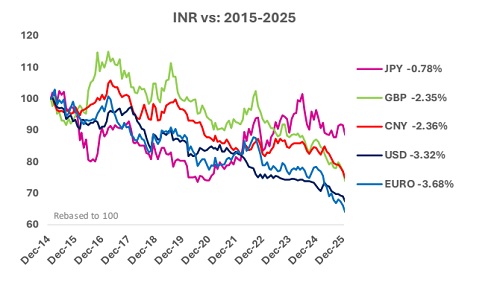
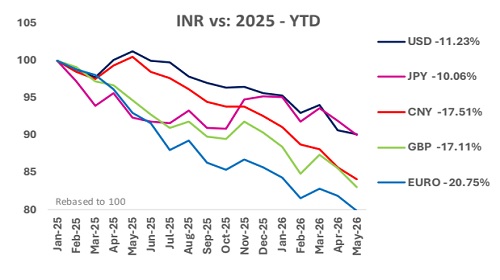
But the pressure building currently carries a different undertone. In a matter of weeks, the rupee has breached the 96 per dollar mark for the first time, even as the RBI has reportedly intervened aggressively to contain volatility. Foreign investors have withdrawn over $20 billion from Indian equities and debt markets since March 2026, Brent crude has climbed above $110 a barrel amid escalating tensions in the Middle East, and India’s foreign exchange reserves have declined sharply from their February peak as the central bank spends dollars to defend the currency.
More so, the rupee is no longer weakening only against the US dollar. It has lost ground against a broader basket of major global currencies linked to trade, capital flows and reserve management - an unusual development for an economy still projected to remain among the world’s fastest-growing large nations. Yet policymakers continue to argue that India’s macroeconomic fundamentals remain robust.
That growing divergence between offcial reassurance and market behavior raises a deeper question: Is the RBI defending the rupee or simply delaying a deeper adjustment?
The immediate triggers for rupee depreciation are easy to identify - Escalating tensions in West Asia, elevated crude oil prices, sustained foreign portfolio outflows, and a stronger US dollar environment. But reducing the rupee’s weakness to a temporary geopolitical shock misses the deeper story unfolding underneath
What India is experiencing today is not merely currency volatility. It could be the visible symptom of emerging structural stress in the country’s external sector.
So is the RBI merely smoothing excessive volatility or is it attempting to resist a fundamentally necessary adjustment in the rupee?
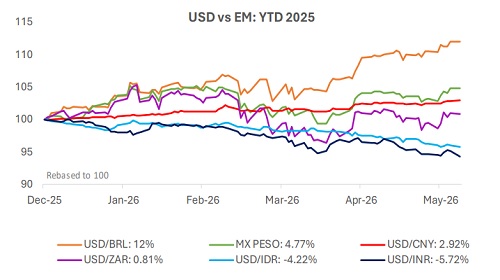
Because the distinction matters. If the rupee is weakening because of short-term panic or speculative positioning - intervention can restore stability. But if depreciation reflects something more structural - persistent import dependence, weakening export competitiveness, slower capital inflows, and a widening current account deficit - then intervention merely delays adjustment while increasing long-term economic costs.
Above views are of the author and not of the website kindly read disclaimer