
CareEdge Ratings expects FY27 fiscal deficit to exceed the budgeted amount by Rs 0.7-0.8 trillion

expects the FY27 fiscal deficit to exceed the budgeted amount by Rs 0.7-0.8 trillion, leading to a fiscal deficit-to-GDP of 4.3-4.5%. However, the Centre could use the Economic Stabilisation Fund (of Rs 1 trillion) to meet its fiscal deficit target.
CareEdge Ratings expects customs duties and GST collections to remain supportive of the gross tax collections exceeding the budget estimates in FY27. However, lower excise duty collections are expected to weigh. Furthermore, income tax collections will need to strengthen during the remaining months to meet the budgeted growth. Factoring all of these aspects, CareEdge Ratings expects a gross tax revenue shortfall of Rs 1 trillion in FY27.
Support from higher dividend transfer and disinvestments could contain the overall slippage in Centre’s overall receipts to Rs 0.5 trillion. On the spending front, CareEdge Ratings expect subsidy burden to be higher by Rs 1.2 trillion which could be offset by some revenue rationalisation and a marginally lower capex. Overall, the total expenditure is expected to exceed the budgeted target by Rs 0.3 trillion. Factoring these aspects, the fiscal deficit could exceed the budgeted amount by Rs 0.7-0.8 trillion leading to a fiscal deficit-to-GDP of 4.3-4.5%. However, the Centre could use the Economic Stabilisation Fund (of Rs 1 trillion) to meet its fiscal deficit target. Thus, CareEdge Ratings does not expect any additional pressure on the Centre’s borrowings for the current year.
Centre’s Tax Collections – H1 FY27
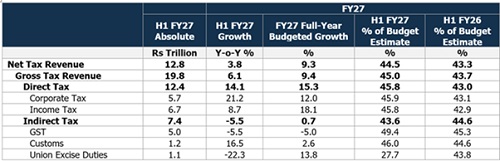
 Source: CGA, CMIE, CEIC, CareEdge; Note: Budgeted full-year growth represents growth in FY27 (Budget estimate) over FY26 (Provisional data)
Disinvestments Stay on Track
The Centre has garnered Rs 0.56 trillion from disinvestments during H1 FY27, which is 70% of the full year budgeted amount of Rs 0.8 trillion. This is notably higher than the disinvestment progress made during the corresponding period last year. The announced IDBI stake sale could fetch around Rs 260 billion. Overall, CareEdge Ratings expects the proceeds from disinvestment and asset monetisation to be higher than the budgeted amount at around Rs 1 trillion.
Dividend Receipts to be Supportive of the Overall Receipts
The Centre had budgeted for Rs 3.2 trillion from RBI, nationalised banks, and financial institutions (FIs) in FY27, of which the dividend surplus from RBI alone amounted to Rs 2.9 trillion. A long-term analysis shows that surplus transfer from the RBI alone has exceeded Rs 2 trillion since FY25. This marks a rise compared to the levels witnessed in the earlier years. Strong dividend payouts from the RBI have provided the Centre with additional fiscal space in recent years. Overall, CareEdge Ratings expects the revenue from dividends/profits marginally exceeding the budgeted amount.
Capex Stays on Track
The Centre's capex increased by 12.7% in H1 FY27. Within capital spending, the Ministry of Railways and the Ministry of Road Transport and Highways continued to account for the largest share of capex.
Centre's capital expenditure excluding outgo to Department of Food & Public Distribution (DFPD) grew by an even higher 14% y-o y. The Centre also front-loaded capital transfers to states, likely driven by higher disbursements under the Special Assistance to States for Capital Investment (SASCI) scheme. Capital transfers to states accounted for 13.4% of total capital spending in H1 FY27, up from 9.8% a year ago. Overall, CareEdge Ratings expects capex for the full year to turn out marginally lower than the budgeted amount.
Revex Faces Pressure from Higher Subsidies
Within revenue expenditure, spending on major subsidies grew by 10.1% y-o-y in H1 FY27, driven by higher outgo on food and fertiliser subsidies. Food subsidy expenditure increased by 16% y-o-y, compared to a budgeted contraction of 0.2% in FY27. Fertiliser subsidy expenditure rose by 11.2% y-o-y against the budgeted decline of 19.2%, likely reflecting urea procurement at elevated prices prevailing in April and May 2026 following the onset of the West Asia conflict. However, the upside to the fertiliser subsidy is likely to be much lower than feared earlier with global prices of urea now hovering below pre-conflict levels. For the full year FY27, the subsidy outgo is expected to be higher by Rs 1.2 trillion, compared to budgeted figures. CareEdge Ratings project fertiliser subsidy to be higher by around Rs 1 trillion and a marginally higher-than-budgeted food subsidy.
CareEdge View on Fiscal Outlook - FY27
Looking ahead, gross tax collections are expected to be adversely impacted by a likely slippage in income tax and excise duty collections. However, higher revenue collections from GST and customs duty are expected to partially offset these shortfalls. Overall, we estimate gross tax revenue to fall short of the budget estimate by around Rs 1 trillion. Support from higher dividend transfers and disinvestments could contain the overall slippage in the Centre’s overall receipts to Rs 0.5 trillion. On the spending front, we expect the subsidy burden to rise by Rs 1.2 trillion, which could be partially offset by some revenue rationalisation and marginally lower capex. Overall, we expect the total expenditure to exceed the budgeted target by Rs 0.3 trillion. Factoring these aspects, the fiscal deficit could exceed the budgeted amount by Rs 0.7-0.8 trillion, leading to a fiscal deficit-to-GDP of 4.3-4.5%. However, the Centre could use the Economic Stabilisation Fund (of Rs 1 trillion) to meet its fiscal deficit target. Thus, we do not expect additional pressure on the Centre’s borrowings this year.
Above views are of the author and not of the website kindly read disclaimer








Tag News
Government can scrap LTCG tax with limited fiscal impact