Asia shares wary, oil choppy on Hormuz doubts
Asian markets were in a wary mood on Monday as hostilities in the Gulf kept oil prices elevated, complicating an inflation outlook that should keep most central banks on pause at policy meetings this week, barring one possible hike.
In a possible hint of hope, the Wall Street Journal reported the Trump administration plans to announce as early as this week that multiple countries have agreed to form a coalition to escort ships through the Strait of Hormuz.
U.S. President Donald Trump told the Financial Times it would be very bad for the future of NATO if the allies did not help.
European Union foreign ministers will discuss on Monday bolstering a small naval mission in the Middle East, though any operation in the Strait would be fraught with risk.
Oil markets were cautious as Brent rose 0.8% to $104.01 a barrel, while U.S. crude fell 0.2% to $98.48. [O/R]
Central banks in the U.S., UK, Europe, Japan, Australia, Canada, Switzerland and Sweden hold their first full meetings since the start of the war, with energy prices looming over all of them.
"Central bank forecasts will immediately bias towards higher inflation and lower growth," said Bruce Kasman, chief economist at JPMorgan. "Consistent with this view, we have pushed back or removed action for most central banks that were expected to move in March and April."
"Developments on the ground highlight the potential for further price increases and the likelihood that the risk premium will remain elevated."
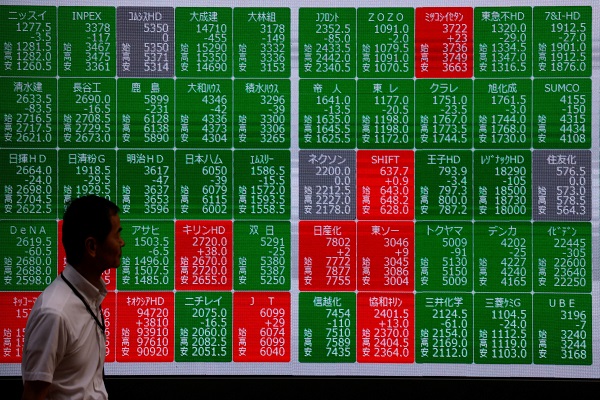
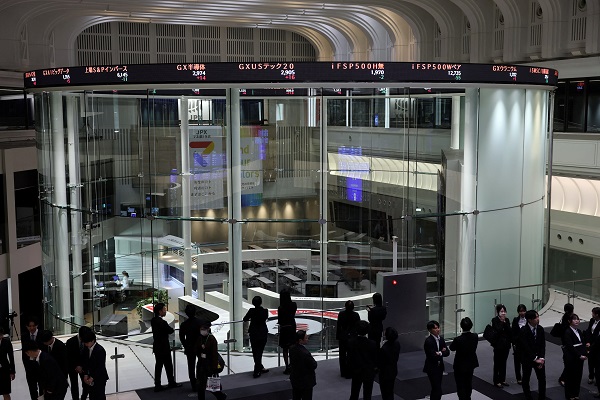
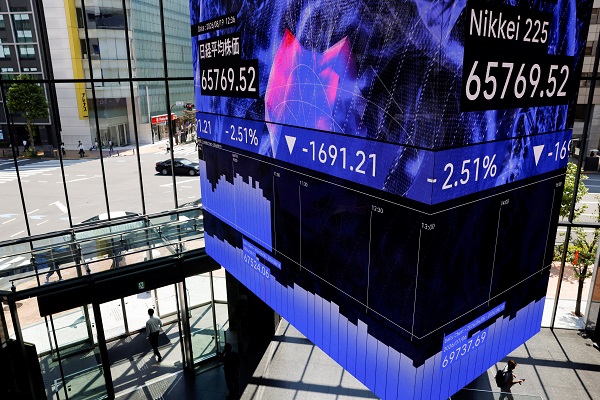
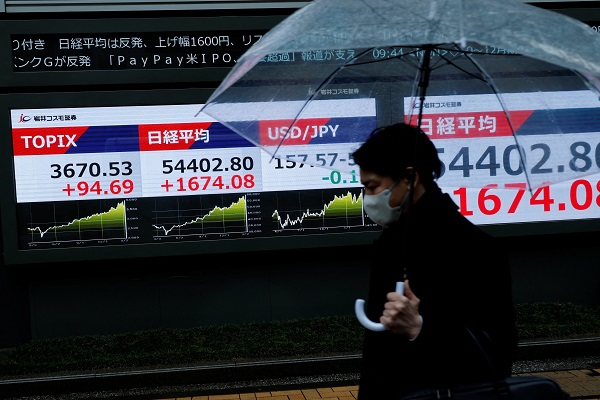
Japan's Nikkei dipped 0.8%, while South Korean stocks added 0.2% after both lost ground last week. MSCI's broadest index of Asia-Pacific shares outside Japan edged down 0.1%.
Chinese blue chips eased 0.5% as data showed retail sales and industrial output for January and February topped forecasts, while house prices continued to slip.
Top U.S. and Chinese officials are also meeting in Paris to discuss potential deals in agriculture, critical minerals and managed trade for Trump and Chinese President Xi Jinping to consider when the U.S. president visits in Beijing.
ALL THE CENTRAL BANKS
For Europe, EUROSTOXX 50 futures and DAX futures both rose 0.2%, while FTSE futures added 0.3%.
S&P 500 futures and Nasdaq futures bounced 0.4% in choppy trading. While earnings season is over, concerns about AI will be front and centre as Nvidia hosts its GTC conference at Silicon Valley this week, where it is expected to show off the latest advances in chips and AI infrastructure.
The coming energy shock, combined with pressure on fiscal budgets from higher defence spending, saw double-digit increases in bond yields globally last week.
Ten-year Treasury yields were at 4.267%, having climbed 32 basis points since the war began, while futures have sharply scaled back the scope for future rate cuts.
The Federal Reserve is considered certain to hold on Wednesday and the chance of an easing by June has come down to just 26%, from 69% a month ago.
Investor attention will be on the tone of the statement and press conference, and whether the median "dot plot" projections from policymakers remove any further easing for this year.
A cautiously steady outcome is expected at the other central bank meetings, bar the Reserve Bank of Australia which is seen likely to hike its cash rate a quarter point to 4.1% as it battles resurgent inflation at home.
The heightened volatility in markets has tended to benefit the U.S. dollar as a store of liquidity. The United States is also a net energy exporter, giving it a relative advantage over Europe and much of Asia, which are net importers.
The dollar was trading a touch lower early on Monday, partly in reaction to the report that shipping might be escorted through the Strait of Hormuz.
The dollar eased to 159.47 yen, just off a 20-month top of 159.75, with investors wary in case a break of 160.00 triggers more warnings of intervention from Japan.
The euro was stuck near a seven-month low at $1.1445, threatening a breach of major chart support at $1.1392 that could unleash a retreat towards $1.1065.
In commodity markets, gold was little changed at $5,012 an ounce, having so far seen scant support as a safe haven or as a hedge against inflation risks. [GOL/]